What a no KYC SMS API Philippines actually is
A no KYC SMS API Philippines is a messaging API you can use and pay for without completing Know-Your-Customer identity verification. No company registration documents, no business vetting call, no waiting days for approval. You fund a balance (typically in crypto), get an API key, and send SMS to Philippine mobile numbers immediately. It's the opposite of enterprise onboarding that gates most providers. For the authoritative reference, see the IETF idempotency-key draft.
Filipino devs reach for this for three reasons: instant start, privacy, and crypto billing (especially USDT). The BSP's 2025 move to push bank OTP off SMS changed the landscape. But non-bank OTP and transactional alerts still route cleanly via international no-KYC routes. This guide covers what works, what doesn't, and the honest trade-offs. SMSRoute's published route pages list delivery from $0.004/message (premium direct-carrier corridors up to $0.035) with sub-100ms median submission and ~98.6% delivered success (smsroute.cc route pages, 2026).
The BSP change and what it means for no-KYC SMS
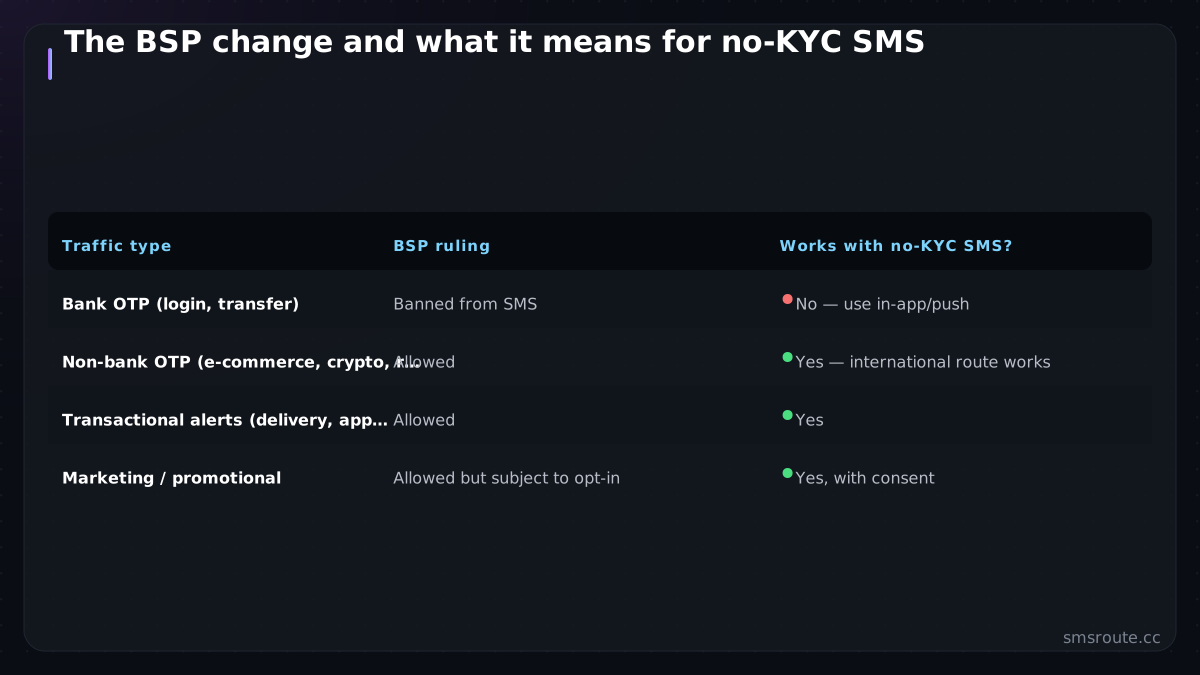
In 2025, the Bangko Sentral ng Pilipinas (BSP) told banks to stop sending OTP via SMS for financial transactions. Rising SMS phishing was the reason (see BSP Memorandum M-2025-012). So bank OTP — login codes, transfer confirmations — must now use in-app or push channels. Non-bank OTP (e-commerce, social media, crypto exchanges, ride-hailing) is not affected.
| Traffic type | BSP ruling | Works with no-KYC SMS? |
|---|---|---|
| Bank OTP (login, transfer) | Banned from SMS | No — use in-app/push |
| Non-bank OTP (e-commerce, crypto, ride-hailing) | Allowed | Yes — international route works |
| Transactional alerts (delivery, appointment) | Allowed | Yes |
| Marketing / promotional | Allowed but subject to opt-in | Yes, with consent |
Here's the bottom line: if your use case is non-bank OTP or transactional, a no-KYC SMS API Philippines stays fast and private. The BSP ruling doesn't block SMS itself. It blocks specific bank use cases. For everything else, the route is open.
Legitimate reasons to use a no-KYC SMS API in the Philippines
- Speed to first messagePrototypes and launches can't wait days for account approval. Fund a balance, get a key, and send the same afternoon — the 5-line integration is the whole setup.
- Privacy and minimal data footprintNot every team wants to hand a full corporate identity to a messaging vendor. No-KYC keeps your data footprint minimal — you share what's needed to route messages, not a KYC dossier. This is the single most-cited reason in this market.
- Crypto-native billingIf you already operate in crypto, paying for SMS in USDT, BTC, or ETH avoids card rails entirely — useful for crypto exchanges, Web3 apps, and teams without a traditional corporate card. See paying for a SaaS with Bitcoin.
- International and transactional reachFor OTP and transactional traffic to the Philippines, an international route often delivers cleanly without domestic registration — the pattern mapped across the global compliance guide.
No-KYC is not a synonym for 'no rules'. It removes vendor-side identity friction — it does not remove Philippine laws. Consent, opt-out, sender-ID registration, and quiet hours still apply per the Philippines SMS guide. No-KYC changes how you sign up and pay; it doesn't change what's legal to send.
The honest limits for Philippines SMS
Here's where no-KYC is the wrong tool. Bank OTP: as noted, BSP rules prohibit SMS for financial OTP. No provider, KYC or not, can deliver bank OTP via SMS. High-volume branded marketing: domestic sender-ID registration (like Smart's or Globe's alphanumeric sender) may require local presence. Regulated industries: if you're sending for gambling or adult content, Philippine law (Republic Act 10175) requires additional compliance.
The clean mental model: no-KYC excels at non-bank OTP, transactional alerts, international routes, privacy-sensitive sending, and fast starts. It is not a workaround for laws that require registered identity. Match your traffic to the tool. For the lanes it fits, it's dramatically faster and more private than the enterprise path. For the lanes it doesn't, use registration where the law demands it.
How to start with SMSRoute for Philippines SMS in five minutes
- Fund a balance in cryptoTop up with BTC, ETH, USDT, XMR, LTC, or SOL. No card, no invoice, no identity document. Your balance is ready as soon as the transaction confirms.
- Grab your API keyThe key appears in your dashboard immediately. There's no approval queue to sit in.
- Send your first message to a Philippine numberOne HTTPS POST sends an SMS. The curl quickstart is a copy-paste starting point, and swapping an existing Twilio call is the 5-line job.
- Add rate limits and opt-outWire in OTP best practices. Use attempt caps, short expiry, and honor opt-outs per Philippine regulations. No-KYC start, compliant sending.
SMSRoute is a no-KYC SMS API with crypto billing (BTC, ETH, USDT, XMR, LTC, and SOL): minutes to first message, minimal data footprint, and international routes for OTP and transactional traffic to the Philippines. It's built for exactly the lanes above. Fast, private, crypto-native SMS. And honest about the bank-OTP lane it isn't for. If your traffic is non-bank OTP, transactional alerts, or privacy-sensitive sending, it's a direct fit.
FAQ
What is a no KYC SMS API Philippines?
Can I send bank OTP via SMS in the Philippines?
Can I pay for a Philippines SMS API with crypto?
Is a no KYC SMS API legal in the Philippines?
How fast can I start sending SMS to the Philippines?
Send your first SMS in 5 minutes
No KYC. Pay with BTC, ETH, USDT, XMR, LTC, and SOL. Live routes to 149 countries.
Get an API key →