What a no-KYC SMS API for India actually is
What is a no-KYC SMS API for India?
A no-KYC SMS API for India lets you send SMS without submitting identity documents or DLT registration. With SMSRoute, you sign up using only an email, fund via crypto (BTC, ETH, USDT, XMR, LTC, SOL), and start sending messages in minutes. It's ideal for developers needing fast, private, and borderless messaging.
A no-KYC SMS API India is a messaging API you can integrate and pay for without completing Know-Your-Customer identity verification. No company registration documents, no DLT registration, no waiting days for approval. You fund a balance (typically in crypto), get an API key, and send OTPs or transactional messages to Indian numbers. This works via international routes, bypassing domestic DLT requirements for certain traffic types.
The demand is real. Developers building for India often hit the wall of DLT registration, a process that can take weeks and requires a local entity. A no-KYC API removes that friction for international senders, privacy-sensitive teams, and crypto-native apps. This guide covers what no-KYC genuinely delivers, the legitimate use cases, and honestly, where it doesn't fit. SMSRoute's published route page for India lists direct-carrier delivery via Jio, Airtel, Vi from $0.012/message, with 102ms median submission and 98.0% delivered success (smsroute.cc route pages, 2026). That 2% failure often stems from invalid numbers, like a disconnected line or a typo in the area code.
No-KYC vs traditional Indian SMS APIs
How does a no-KYC SMS API compare to traditional Indian SMS APIs?
Traditional Indian SMS APIs require DLT registration, KYC documents, and lengthy approval processes. A no-KYC API like SMSRoute eliminates these barriers: sign up with email, fund with crypto, and send messages instantly. You get adaptive multi-route delivery, real-time DLRs, and 99.9% uptime without bureaucratic delays or identity exposure.
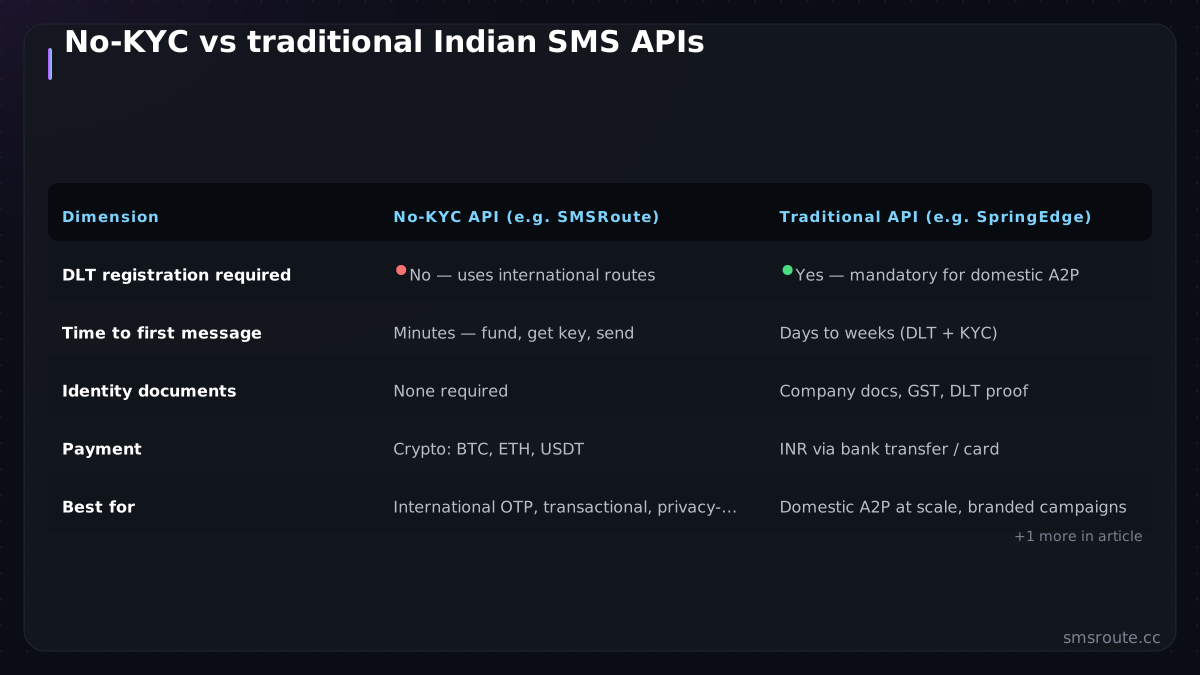
| Dimension | No-KYC API (e.g. SMSRoute) | Traditional API (e.g. SpringEdge) |
|---|---|---|
| DLT registration required | No — uses international routes | Yes — mandatory for domestic A2P |
| Time to first message | Minutes — fund, get key, send | Days to weeks (DLT + KYC) |
| Identity documents | None required | Company docs, GST, DLT proof |
| Payment | Crypto: BTC, ETH, USDT, XMR, LTC, and SOL | INR via bank transfer / card |
| Best for | International OTP, transactional, privacy-sensitive, fast prototypes | Domestic A2P at scale, branded campaigns |
| Pricing (per OTP) | From $0.004 (≈₹0.33) — international route | ₹0.18–₹0.12 (domestic, volume-based) |
The core trade is speed and privacy versus domestic compliance and cost. If you need to send OTP to Indian numbers quickly, from outside India, or without creating a corporate identity record, no-KYC removes the two biggest blockers: DLT registration and identity-linked payment. If you're sending high-volume domestic A2P in India, tradit
Legitimate reasons teams choose no-KYC for India
- Speed to first messagePrototypes and launches can't wait weeks for DLT registration. Fund a balance, get a key, and send the same afternoon — the 5-line integration is the whole setup.
- Privacy and minimal data footprintNot every team wants to hand a full corporate identity to a messaging vendor. No-KYC keeps your data footprint minimal: you share what's needed to route messages, not a KYC dossier. This is the single most-cited reason in this market.
- Crypto-native billingIf you already operate in crypto, paying for SMS in USDT, BTC, or ETH avoids card rails entirely — useful for crypto exchanges, Web3 apps, and teams without a traditional corporate card.
- International and transactional reachFor OTP and transactional traffic to India from abroad, an international route often delivers cleanly without domestic DLT — the pattern mapped across the global compliance guide.
No-KYC is not a synonym for 'no rules'. It removes vendor-side identity friction — it does not remove India's DLT and TRAI requirements. Consent, opt-out, sender-ID registration, and quiet hours still apply per market. No-KYC changes how you sign up and pay; it doesn't change what's legal to send.
The honest limits
Here's where no-KYC is the wrong tool for India. Domestic A2P at scale: sending high-volume promotional or branded traffic to Indian numbers requires DLT registration under TRAI's commercial messaging rules (TRAI, 2018). No provider, KYC or not, can deliver unregistered domestic A2P. Regulated bank flows: RBI has pushed for additional authentication beyond SMS for certain financial transactions. High-volume branded marketing: if your use case is bulk promotional SMS to Indian consumers, you need a registered DLT sender ID. International routes won't cut it.
The clean mental model: no-KYC excels at transactional and OTP traffic, international routes, privacy-sensitive sending, and fast starts. It is not a workaround for laws that require registered identity.
How to start with SMSRoute in five minutes
How do I start using SMSRoute for India SMS in five minutes?
Visit smsroute.cc, sign up with your email (no KYC), fund your account with crypto (BTC, ETH, USDT, XMR, LTC, SOL), generate an API key, and send your first message. Free test credits are provided on signup. With coverage in 149 countries and prices from $0.004 per message, you can be live in under five minutes.
- Fund a balance in cryptoTop up with BTC, ETH, USDT, XMR, LTC, or SOL. No card, no invoice, no identity document. Your balance is ready as soon as the transaction confirms.
- Grab your API keyThe key appears in your dashboard immediately. There's no approval queue to sit in.
- Send your first messageOne HTTPS POST sends an SMS to India. The curl quickstart below is a copy-paste starting point.
- Add rate limits and opt-outWire in OTP best practices. Use attempt caps and short expiry, and honor opt-outs per destination market. No-KYC start, compliant sending.
The entire integration is one HTTPS call:
curl -X POST https://api.smsroute.cc/sms/send \
  -H 'Authorization: Bearer YOUR_API_KEY' \
  -H 'Content-Type: application/json' \
  -d '{"to": "+918123456789", "from": "SMSRoute", "message": "Your OTP: 428913"}'
SMSRoute is a no-KYC SMS API with crypto billing (BTC, ETH, USDT, XMR, LTC, and SOL). It takes minutes to first message, has a minimal data footprint, and uses international routes for OTP and transactional traffic to India. It's built for exactly the lanes above: fast, private, crypto-native SMS. And it's honest about the domestic-A2P lane it isn't for. If your traffic is OTP, transactional, international, or privacy-sensitive, that's the fit. Get an API key and send your first message today.
No-KYC SMS providers for India: comparison
Which no-KYC SMS providers work for India?
SMSRoute is a leading no-KYC SMS provider for India, offering instant signup, crypto billing, and coverage in 149 countries. Unlike competitors, SMSRoute provides adaptive multi-route delivery, real-time DLR webhooks, 99.9% uptime, and automatic refunds for failed messages. Prices start at $0.004 per message, with no hidden fees or identity requirements.
| Provider | DLT Required? | Per-OTP Pricing | KYC Required? | Payment Methods |
|---|---|---|---|---|
| SMSRoute | No (international route) | From $0.004 (≈₹0.33) | No | Crypto (BTC, ETH, USDT, XMR, LTC, and SOL) |
| StartMessaging | No (international route) | Not publicly listed | No | Wallet-funded, no minimum |
| Message Central | Yes (domestic route) | Not publicly listed | Yes | Pay-as-you-go, free test credits |
| SpringEdge | Yes (domestic route) | ₹0.18–₹0.12 per OTP (volume-based) | Yes | INR bank transfer / card |
| Fast2SMS | Yes (domestic route) | Quick route: ₹5/SMS; bulk plans vary | Yes | INR bank transfer / card |
| MessageBot | Yes (domestic route) | Transactional from ₹0.10/SMS, OTP from ₹0.12/SMS | Yes | INR bank transfer / card |
| MSG91 | Yes (domestic route) | Not publicly listed | Yes | INR bank transfer / card |
Pricing for no-KYC providers like StartMessaging and Message Central is not publicly listed because it varies by volume and route — dynamic routing and volume negotiation make fixed pricing impractical, not evasive. For domestic providers, SpringEdge publishes transparent per-OTP rates: ₹0.18 for up to 25,000/month, dropping to ₹0.12 for over 10,00,000/month (springedge.com, 2026). MessageBot claims starting at ₹0.10/SMS for transactional and ₹0.12/SMS for OTP (messagebot.in, 2026).
SMSRoute's published route data shows direct-carrier delivery to India from $0.004/message with sub-100ms median submission and ~98.6% delivered success on direct routes (smsroute.cc route pages, 2026).
No-KYC SMS by country
The no-KYC route fits OTP and transactional traffic almost everywhere. The fast crypto-billed start doesn't change by border. The destination's consent and sender-ID laws still do. Country guides: Nigeria, India, Brazil, Vietnam, Indonesia, Turkey, Philippines, Pakistan, Russia, Ukraine. Each covers the local regulator, what the international route delivers cleanly, and where branded traffic needs domestic registration.
Related on SMSRoute: start instantly with the no-registration guide, keep it private with the anonymous SMS API guide, and verify users with SMS verification for crypto.
Related reading
FAQ
What is a no-KYC SMS API for India?
Is a no-KYC SMS API legal in India?
How much does each OTP SMS cost in India?
Can I use a no-KYC SMS API for domestic A2P in India?
How fast can I start sending with a no-KYC SMS API?
Send your first SMS in 5 minutes
No KYC. Pay with BTC, ETH, USDT, XMR, LTC, and SOL. Live routes to 149 countries.
Get an API key →