
What a no KYC SMS API Brazil actually is
A no KYC SMS API Brazil is a messaging API you can use without Brazilian identity documents (CPF/CNPJ) or ANATEL registration. You fund a crypto balance, get an API key, and send international OTP or transactional SMS to Brazilian numbers in minutes. There is no vetting call or paperwork.
Brazil has high crypto adoption. Over 40 million Brazilians owned crypto in 2025 (per Chainalysis, 2025). For Web3 apps, crypto exchanges, and international services, a no-KYC API with crypto billing is a natural fit. This guide covers what works, what doesn't, and how to start with SMSRoute's no-KYC SMS API. SMSRoute's published route pages for Brazil list direct-carrier delivery via Vivo, Claro, TIM from $0.018/message, with 104ms median submission and 98.1% delivered success (smsroute.cc route pages, 2026). Messages are sent via REST API with JSON payloads, and each message is automatically segmented using GSM-7 or UCS-2 encoding as needed. These figures are aggregated from live route performance data. View the current stats directly at smsroute.cc/route/brazil.
No-KYC vs ANATEL-registered SMS in Brazil
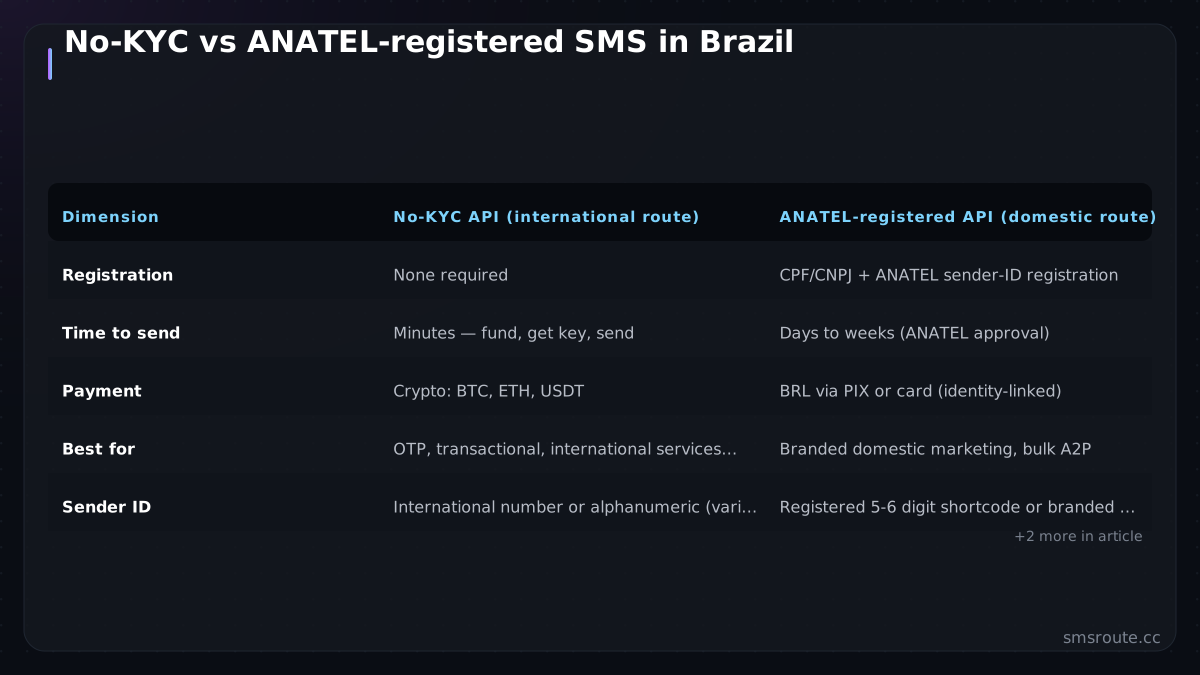
| Dimension | No-KYC API (international route) | ANATEL-registered API (domestic route) |
|---|---|---|
| Registration | None required | CPF/CNPJ + ANATEL sender-ID registration |
| Time to send | Minutes — fund, get key, send | Days to weeks (ANATEL approval) |
| Payment | Crypto: BTC, ETH, USDT, XMR, LTC, and SOL | BRL via PIX or card (identity-linked) |
| Best for | OTP, transactional, international services, crypto apps | Branded domestic marketing, bulk A2P |
| Sender ID | International number or alphanumeric (varies) | Registered 5-6 digit shortcode or branded sender |
| LGPD compliance | Your responsibility (consent, opt-out) | Your responsibility + ANATEL audit |
| US branded 10DLC | Not supported | Not supported (US-specific regime) |
The core trade: no-KYC removes registration friction and enables crypto billing. But it cannot deliver branded domestic A2P traffic that requires ANATEL registration. For OTP and transactional messages from international senders, it works fine.
Legitimate reasons teams choose no-KYC for Brazil
- Speed to first messagePrototypes and launches can't wait for ANATEL approval. Fund a crypto balance, get a key, and send the same afternoon. The 5-line integration is the whole setup.
- Crypto-native billingBrazil is a top crypto market. Paying for SMS in USDT, BTC, or ETH avoids BRL card rails and identity-linked invoices. This is useful for crypto exchanges, DeFi apps, and any team operating in crypto.
- Privacy and minimal data footprintNot every team wants to hand over CPF/CNPJ to a messaging vendor. No-KYC keeps your data footprint minimal: you share only what's needed to route messages, not a KYC dossier.
- International OTP and transactional reachFor OTP and transactional traffic from outside Brazil, an international route often delivers without domestic sender-ID registration. This pattern is mapped in the Brazil SMS API guide.
No-KYC is not a synonym for 'no rules'. It removes vendor-side identity friction. It does not remove Brazil's LGPD or ANATEL regulations. Consent, opt-out, and sender-ID registration still apply under LGPD and ANATEL rules. No-KYC changes how you sign up and pay; it doesn't change what's legal to send.
The honest limits for Brazil
A guide that only sold you the upside would be worthless. Here's where no-KYC is the wrong tool for Brazil. Branded domestic A2P: sending marketing or branded traffic to Brazilian mobile numbers with a domestic sender ID (e.g., a 5-digit shortcode) requires ANATEL registration tied to a CNPJ. No provider, KYC or not, delivers unregistered branded domestic traffic. Bank OTP: some Brazilian banks have moved OTP to app-based push due to SMS fraud. Check with your target carrier. High-volume domestic marketing: if you need a Brazilian shortcode or alphanumeric sender, you must register with ANATEL regardless of how you pay.
The clean mental model: no-KYC excels at international OTP, transactional traffic, crypto-native billing, and fast starts. It is not a workaround for laws that require registered identity. Match your traffic to the tool. For the lanes it fits, it's dramatically faster and more private. For the lanes it doesn't, use registration where the law demands it.
How to start with SMSRoute for Brazil in five minutes
- Fund a balance in cryptoTop up with BTC, ETH, USDT, XMR, LTC, or SOL — no card, no invoice, no identity document. Your balance is ready as soon as the transaction confirms (typically after a few blockchain confirmations).
- Grab your API keyThe key appears in your dashboard immediately — there's no approval queue to sit in.
- Send your first message to BrazilOne HTTPS POST sends an SMS to a Brazilian number (+55) in international format (E.164). The curl quickstart is a copy-paste starting point.
- Wire in LGPD complianceEnsure you have consent and an opt-out mechanism. Brazil's LGPD requires a lawful basis for processing personal data — SMS content counts. See the global compliance guide for details.
SMSRoute is a no-KYC SMS API with crypto billing (BTC, ETH, USDT, XMR, LTC, and SOL): minutes to first message, minimal data footprint, and international routes for OTP and transactional traffic to Brazil. It's built for exactly the lanes above — fast, private, crypto-native SMS — and honest about the domestic-branded lane it isn't for.
Related reading
FAQ
What is a no KYC SMS API Brazil?
Is a no KYC SMS API legal in Brazil?
Can I pay for an SMS API with crypto in Brazil?
Can I use a no KYC SMS API for domestic branded A2P in Brazil?
How fast can I start sending to Brazil with a no KYC SMS API?
Send your first SMS in 5 minutes
No KYC. Pay with BTC, ETH, USDT, XMR, LTC, and SOL. Live routes to 149 countries.
Get an API key →