The failure that justifies the architecture
Why do I need a multichannel OTP fallback architecture?
Single-channel OTP delivery fails due to carrier outages, network congestion, or spam filters. SMSRoute's multichannel fallback architecture automatically retries failed sends across alternative routes and channels, ensuring your users always receive their OTP. With 149 countries covered and 99.9%+ uptime, you get reliable delivery without manual intervention.
Every verification channel fails someone. SMS misses 1-5% of users on good routes; SNA covers ~80%; WhatsApp only reaches installed users; email lands in spam. Individually, each gap is a chunk of stranded signups. Together, ordered as a multichannel OTP fallback, they cover for each other and recover 90%+ of the failures any single channel would eat. The architecture is not complexity for its own sake: it is the difference between a 96% and a 99.5% verification completion rate, which at scale is a lot of users and revenue. For the authoritative reference, see NIST SP 800-63B.
The catch: a fallback ladder done wrong is worse than no fallback. Duplicate codes, cross-channel fraud, and inconsistent state can all arise. Get three things right and it just works.
Ordering the ladder
How do I set up the priority order for OTP fallback channels?
Define your fallback ladder by channel priority—SMS first, then email, then voice or WhatsApp. SMSRoute's API lets you configure this order per destination. The system automatically escalates down the ladder only when the previous channel fails, minimizing cost while maximizing delivery success. Test with free credits on signup.
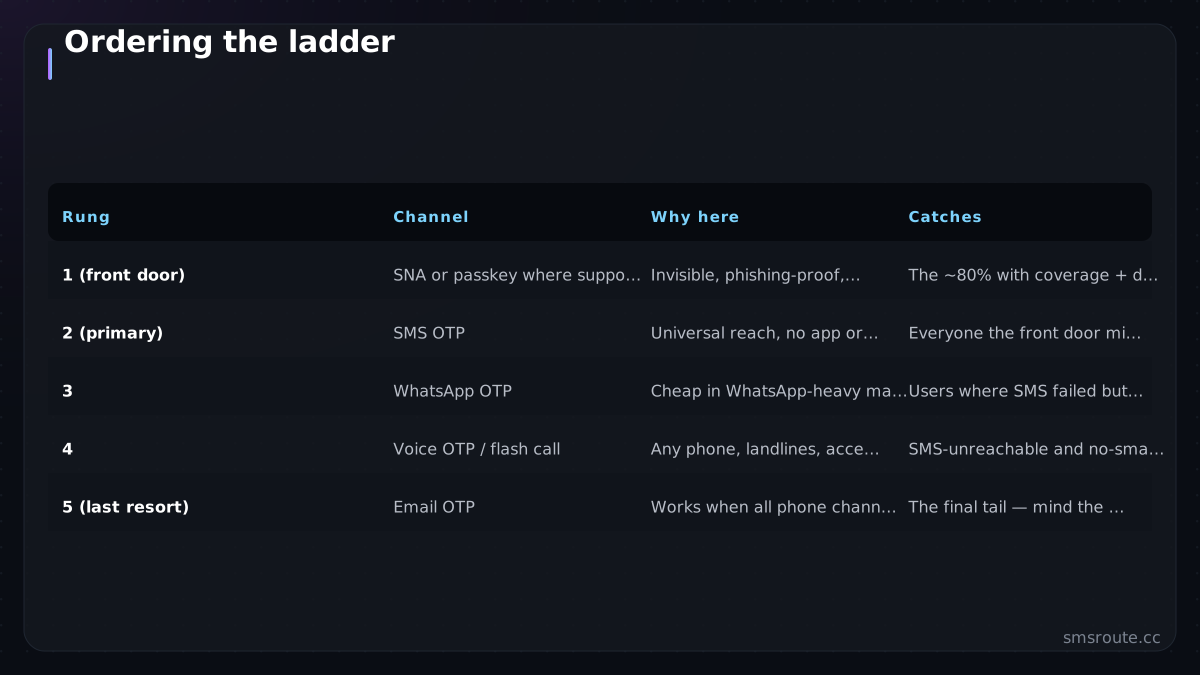
Order by a blend of cost, reach, and security fit for your audience.
| Rung | Channel | Why here | Catches |
|---|---|---|---|
| 1 (front door) | SNA or passkey where supported | Invisible, phishing-proof, high completion | The ~80% with coverage + data |
| 2 (primary) | SMS OTP | Universal reach, no app or data needed | Everyone the front door missed |
| 3 | WhatsApp OTP | Cheap in WhatsApp-heavy markets | Users where SMS failed but WhatsApp reaches |
| 4 | Voice OTP / flash call | Any phone, landlines, accessibility | SMS-unreachable and no-smartphone users |
| 5 (last resort) | Email OTP | Works when all phone channels fail | The final tail — mind the circular-dependency trap |
What stays constant is that SMS sits high for its unmatched reach, and each rung only fires when the one above genuinely failed.
Beware the email rung's hidden dependency: if the user's email is itself protected by SMS OTP, email fallback inherits SMS's weakness — the circular trap our SMS vs email OTP piece details.
The three things that must be shared
What shared components are needed for multichannel OTP fallback?
Three components must be shared across channels: a unique session ID to track the OTP attempt, the OTP code itself, and the user's contact identifier (phone or email). SMSRoute's API handles this seamlessly, ensuring consistent state across fallback steps without extra development overhead.
- One code, one storeGenerate the code once, hash it with a TTL, and verify against that single record regardless of which channel delivered it. Never mint a new code per channel: that multiplies your attack surface and confuses users who got two.
- One rate limit, spanning all channelsPer-number and per-IP caps must count SMS + WhatsApp + voice + email together. A per-channel limit lets a fraudster pull the same code down four ways: the cross-channel pumping hole. The rate-limit design guide covers the token-bucket mechanics.
- One verification state machinePending → sent (which channel) → delivered → verified/expired, in one place. Fallback transitions read this state, so a late delivery on rung 2 doesn't fire rung 3 after the user already succeeded.
Flash call is the one exception to 'one code': its proof is the calling number, not a shared secret. Model it as a distinct verification type that still writes into the same state machine: the nuance from our voice OTP guide.
Triggering and measuring
How do I trigger fallback and measure its success?
Trigger fallback automatically when the primary channel returns a delivery failure or timeout. SMSRoute provides real-time DLR webhooks and a dashboard log to measure each step's success rate. Track metrics like fallback activation rate and average delivery time to optimize your ladder. Unused balance is refundable.
- Trigger on real signals, not blind timers. Use delivery receipts to know a send failed before escalating; fall back on a timeout only when no DLR arrives.
- Give the user a manual escalate. A 'didn't get it? try another way' button often beats any automatic ladder: the user knows their situation.
- Measure completion, not delivery. End-to-end verified rate after fallback is the number that matters; per-channel delivery rates are inputs to it.
- Watch fallback frequency per market. If rung 3+ fires often in a region, your primary channel is weak there: a routing or provider signal, not just a UX one.
SMSRoute is a no-KYC SMS API with crypto billing (BTC, ETH, USDT, XMR, LTC, and SOL). In this architecture we are the high-reach primary rung: the universal catcher that most fallback ladders lean on hardest because SMS reaches phones no other channel can. Build the shared code, rate limit, and state machine once, wire SMS in via the 5-line integration, and layer the other channels.
Related reading
FAQ
What is a multichannel OTP fallback?
What order should OTP fallback channels go in?
How do I stop fallback from double-sending codes?
Do multichannel OTP fallbacks create fraud risk?
Send your first SMS in 5 minutes
No KYC. Pay with BTC, ETH, USDT, XMR, LTC, and SOL. Live routes to 149 countries.
Get an API key →