Same inbox, very different economics
MMS vs SMS looks like a small choice: both land in the same text inbox, but the economics differ sharply. MMS (Multimedia Messaging Service) carries images, longer text (up to 1,600 characters versus SMS's 160), and other media; it also costs three to five times as much per message. In US terms, that's roughly $0.022 per MMS against $0.0083 per SMS segment (Twilio, 2026), before the carrier surcharges that stack on both. So the question is never 'which is better' — it's 'does the media earn its 3-5x premium for this specific message, or would a link in a plain SMS do the same job for a fraction of the cost?'
The differences that matter
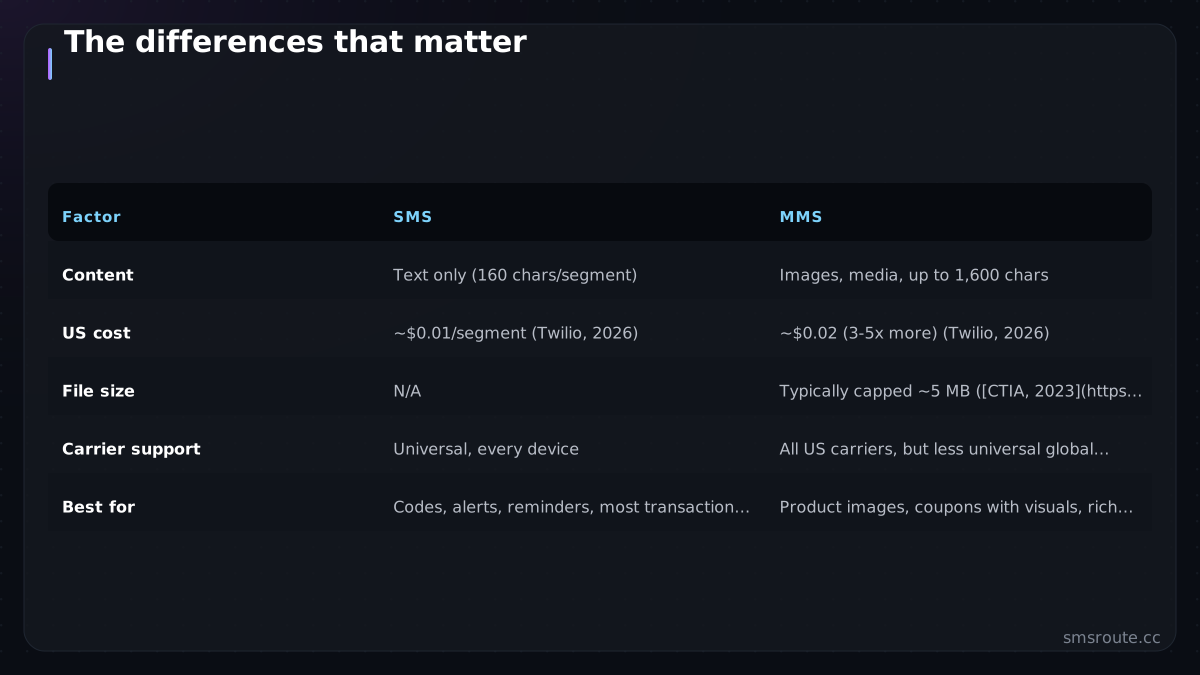
| Factor | SMS | MMS |
|---|---|---|
| Content | Text only (160 chars/segment) | Images, media, up to 1,600 chars |
| US cost | ~$0.0083/segment (Twilio, 2026) | ~$0.022 (3-5x more) (Twilio, 2026) |
| File size | N/A | Typically capped ~5 MB (CTIA, 2023) |
| Carrier support | Universal, every device | All US carriers, but less universal globally |
| Best for | Codes, alerts, reminders, most transactional | Product images, coupons with visuals, rich promos |
MMS is supported by all US carriers, so domestically it's reliable. But SMS's truly universal, every-device reach is unmatched, which matters for global and low-end-device audiences. And the 1,600-character allowance is genuinely useful for longer content. If your message is just text, that length doesn't justify the MMS premium on its own. SMS concatenation handles longer text too, though each segment incurs its own cost (typically $0.0083 per segment) (Twilio, 2026).
The decision, by message type
- OTP, alerts, reminders, confirmations → SMS. Transactional messages are text by nature. The code, the appointment, the alert need no image. Paying 3-5x for MMS here is pure waste. This is the vast majority of messaging.
- Visual promotions (product shots, coupons, event graphics) → MMS can pay. When an image measurably lifts engagement (a product photo, a scannable coupon, a branded visual), the MMS premium can be worth it for that campaign. Test whether the lift covers the 3-5x cost.
- Longer text without media → still SMS. If you just need more than 160 characters, SMS concatenation handles it, but each segment costs the same per-segment rate (Twilio, 2026). Don't pay MMS prices for length alone.
- Rich, interactive experiences → consider RCS, not MMS. For true interactivity (carousels, buttons, verified sender), RCS is the modern rich channel (with SMS fallback) rather than MMS, which is static media in a text.
The default that saves money: send plain SMS by default and reserve MMS for the messages that genuinely need an image, GIF, or short video.
Where it sits in the channel landscape
MMS occupies a specific niche: static rich media in the native text inbox, at a premium, with strong US carrier support. Above it, RCS offers interactivity and verified branding (falling back to SMS). WhatsApp offers rich messaging to installed users. Below it, plain SMS offers universal reach at the lowest cost. MMS makes sense when you specifically need an image in the native inbox and RCS reach isn't there yet for your audience. That's a real but narrow slot.
SMSRoute is a no-KYC SMS API with crypto billing (BTC, ETH, USDT, XMR, LTC, and SOL) focused on SMS. It's the universal, lowest-cost base of this landscape and the fallback under every rich channel. Our honest framing on MMS vs SMS matches the money: SMS handles the overwhelming majority of messaging (all transactional, most marketing) at a fraction of the cost. MMS earns its premium only when an image measurably lifts a specific campaign. Frame every message as 'does the media pay for itself here', default to SMS, and add MMS deliberately. You'll never overpay 3-5x for a picture the message didn't need. SMSRoute's published route pages list
Quick start with SMSRoute
Send your first SMS via the API in seconds: Your API key is a 32 character alphanumeric string found in your SMSRoute dashboard under API Settings.
curl -X POST https://api.smsroute.cc/sms/send \
  -H "Authorization: Bearer YOUR_API_KEY" \
  -H "Content-Type: application/json" \
  -d '{"to": "+1234567890", "from": "YourBrand", "message": "Your OTP is 123456"}'
Related reading
FAQ
What's the difference between SMS and MMS?
When should I use MMS instead of SMS?
Is MMS worth the extra cost?
Is RCS or MMS better for rich messaging?
Send your first SMS in 5 minutes
No KYC. Pay with BTC, ETH, USDT, XMR, LTC, and SOL. Live routes to 149 countries.
Get an API key →