Same job, different meter
Make and Zapier both do the same core thing: trigger an SMS from an event in another app, with no code. So the Make vs Zapier choice for SMS automation rarely comes down to *can they do it* (both can). It comes down to how they charge, because that single difference can make one several times cheaper than the other for the exact same workflow. Zapier prices per task (each workflow run), while Make prices per operation (each individual step within a workflow). For a 5-step workflow running 10,000 times a month, Zapier charges 10,000 tasks, Make charges 50,000 operations. Compare typical plan costs.
Here's how the pricing models actually play out, plus the other differences (app coverage, complexity) that matter, so you pick by your real workflows rather than a feature-tick.
The pricing difference, made concrete
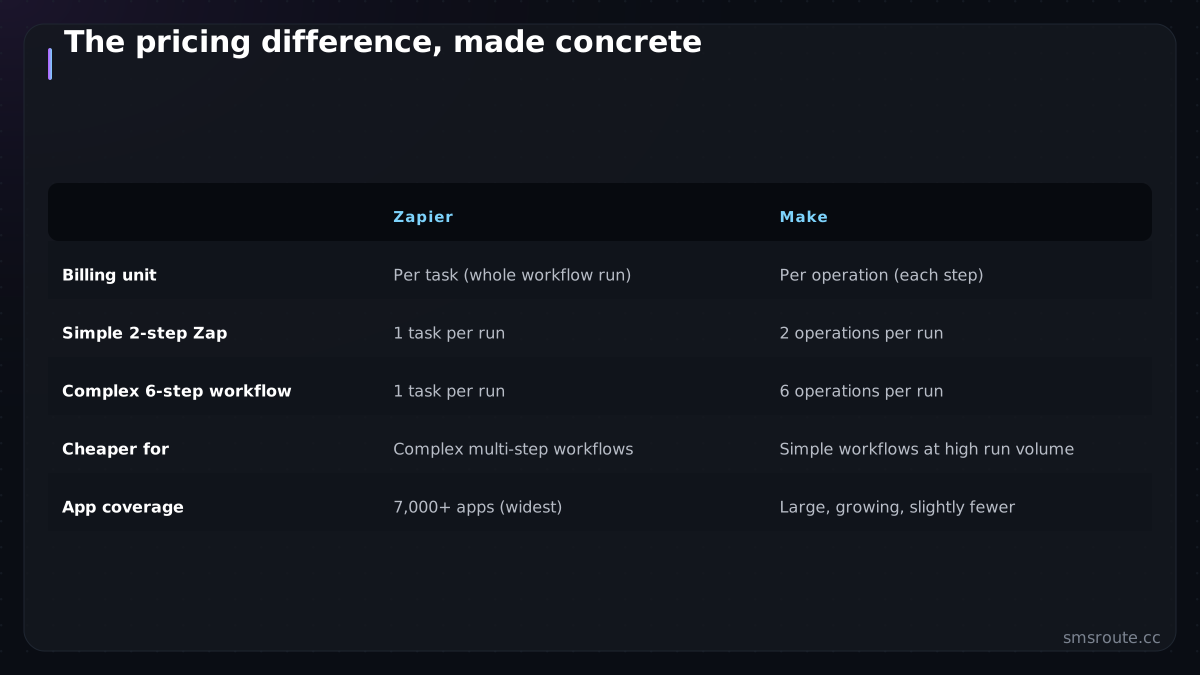
| Zapier | Make | |
|---|---|---|
| Billing unit | Per task (whole workflow run) | Per operation (each step) |
| Simple 2-step Zap | 1 task per run | 2 operations per run |
| Complex 6-step workflow | 1 task per run | 6 operations per run |
| Cheaper for | Complex multi-step workflows | Simple workflows at high run volume |
| App coverage | 7,000+ apps (widest) | Large, growing, slightly fewer |
For a *complex* workflow — many steps per run — Zapier's per-task pricing charges one unit regardless of step count, so a six-step Zap still costs one task, while Make charges six operations. But for a *simple* two-step automation running at high volume, Make's per-operation pricing can undercut Zapier's per-task pricing. Make tends to be more cost-effective at scale for many patterns because operations are granular, but the winner genuinely depends on your workflow's shape and run frequency — count your steps and your monthly runs before assuming. For reference, Zapier's official pricing page details their per-task model (Zapier pricing, 2026).
The other differences
- App coverage: Zapier connects to more apps (7,000+), so if you need an obscure trigger app, it's more likely to have it. Make's library is large but slightly narrower.
- Complexity handling: Make's visual, branching scenario builder handles complex multi-path logic more naturally; Zapier is simpler and more linear, which is easier for basic automations.
- Learning curve: Zapier is more approachable for a first-time no-code user; Make rewards a bit more setup investment with more power and often lower cost.
- Both hit the same ceiling: at real volume, either gets expensive versus a direct SMS API, so neither no-code tool is the endgame for high-volume sending.
Choosing, and the volume ceiling
- Count your workflow's steps and runsMany steps per run favors Zapier's per-task pricing; simple workflows at high run volume can favor Make's per-operation model. Do this math on your actual automation, not in the abstract.
- Check app coverage for your triggerIf your trigger app is niche, confirm both support it — Zapier's wider library is the safer bet for obscure integrations.
- Match the builder to your complexitySimple linear automation → Zapier is quicker. Complex branching logic → Make's visual builder handles it better.
- Watch the volume ceilingBoth price for convenience, not scale. When SMS volume grows, moving the send from a no-code action to a direct API call cuts cost dramatically — the same graduation point either tool eventually hits.
SMSRoute is a no-KYC SMS API with crypto billing (BTC, ETH, USDT, XMR, LTC, and SOL), and the honest framing spans both tools: we're the SMS API you connect through either Make or Zapier's webhook/HTTP action, or call directly when volume outgrows no-code. Make vs Zapier is a real decision for the *trigger and glue* layer — pick by your workflow's step count, run volume, app coverage, and complexity. But whichever you choose, the actual sending can run on a direct API underneath (via their webhook action), keeping the event-wiring no-code while the messaging cost stays low. And when either tool's per-run pricing starts hurting, that's the signal to move sending fully onto the API. SMSRoute's published route pages list delivery from $0.004/message (premium direct-carrier corridors up to $0.035) with sub-100ms median submission and ~98.6% delivered success (smsroute.cc route pages, 2026).
Related on SMSRoute: to wire SMS into your customer records, see the SMS + CRM integration guide.
Related reading
FAQ
Is Make or Zapier cheaper for SMS automation?
What's the difference between Make and Zapier pricing?
Does Make or Zapier have more app integrations?
When should I move from Make or Zapier to a direct SMS API?
Send your first SMS in 5 minutes
No KYC. Pay with BTC, ETH, USDT, XMR, LTC, and SOL. Live routes to 149 countries.
Get an API key →