
Is Anonymous Texting Legal? The Short Answer
Is anonymous texting legal in 2026? The direct answer is yes — when you use an anonymous SMS service for legitimate purposes such as transactional notifications, one-time passwords, or privacy-sensitive communication. The Telephone Consumer Protection Act (TCPA) restricts unsolicited autodialed messages to mobile phones without prior express consent, but it does not prohibit anonymity itself (FCC, 2025).
What makes anonymous texting illegal is the content and intent of the message, not the absence of a sender name. Sending a marketing text to someone on the National Do Not Call Registry without consent can result in fines of $500–$1,500 per violation — whether or not you identify yourself. The same applies to threats, harassment, and fraud.
Legitimate SMS providers like SMSRoute enforce TCPA compliance through rate limits, content filtering, and mandatory opt-out mechanisms. Businesses use a compliant SMS API every day to send OTP codes, delivery alerts, and appointment reminders without exposing their personal phone numbers — and they do so entirely within the law. SMSRoute delivers messages to 149 countries with a median latency under 100ms and a 98.6% average delivery rate, making it one of the fastest and most reliable options for lawful anonymous messaging.
Legal vs. Illegal Anonymous Texting
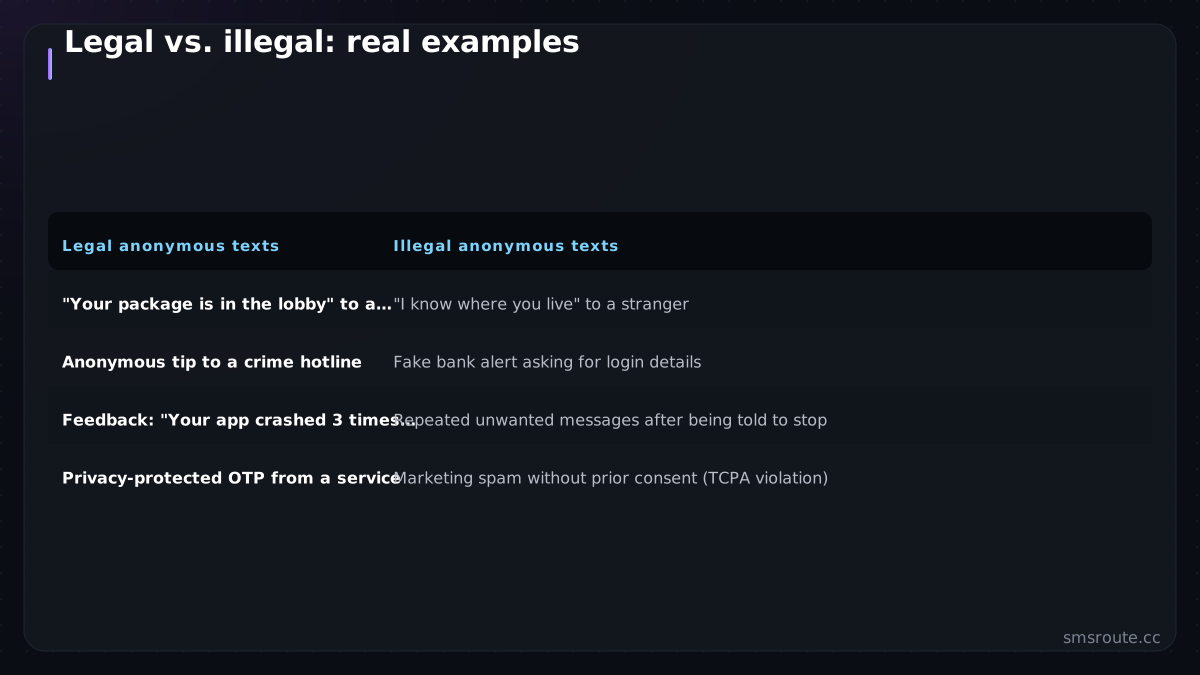
The legality of sending anonymous texts depends on jurisdiction and message content. In the United States, the TCPA and state anti-spam laws govern unsolicited messaging. In the European Union, the GDPR and ePrivacy Directive require prior consent for direct marketing messages. Across Asia, Africa, and Latin America, local telecom regulations vary but consistently prohibit harassment and fraud regardless of sender identification.
| Legal anonymous texts | Illegal anonymous texts |
|---|---|
| "Your package is in the lobby" — to a buyer on a marketplace | "I know where you live" — threats or harassment |
| Anonymous tip to a crime hotline or whistleblower channel | Fake bank alert asking for login credentials (phishing) |
| "Your app crashed 3 times today" — developer feedback via an SMS API | Repeated unwanted messages after the recipient told you to stop |
| OTP code from a service you signed up for | Marketing spam sent without prior express consent (TCPA violation) |
| Healthcare appointment reminder via an SMS gateway | Impersonating a government agency to demand payment |
The difference is consent and content. When the recipient expects the message or has opted in, anonymity is irrelevant. When the message is unwanted, deceptive, or harmful, anonymity does not shield you from liability — courts view anonymous illegal messaging as intentional evasion, often leading to harsher penalties. For organizations needing to send compliant messages across borders, our global SMS pricing page shows transparent rates for all 149 covered countries.
How the TCPA Applies to Anonymous SMS
The TCPA applies to anonymous SMS the same way it applies to any text: it restricts unsolicited autodialed messages, not anonymity. The TCPA, enforced by the FCC, prohibits sending unsolicited autodialed or prerecorded calls and text messages to mobile phones without the recipient's prior express written consent. Anonymous texting is not specifically addressed in the statute, which means the same rules apply whether or not you display a sender name. Violations carry statutory damages of $500 per text, trebled to $1,500 for willful violations.
For legitimate SMS providers, TCPA compliance means:
- Consent verification — ensuring every recipient has opted in before sending marketing messages
- Opt-out enforcement — processing STOP or UNSUBSCRIBE replies within the legally required timeframe
- Content screening — blocking messages that contain phishing links, threats, or fraudulent claims
- Sender identification — providing accurate routing information so carriers can trace messages if needed
If you use an SMS API for transactional messaging such as OTP delivery or order confirmations, TCPA consent is typically built into your terms of service — the recipient's action of entering their phone number constitutes consent. For marketing messages, you need explicit opt-in records. For more detail, see our SMS marketing compliance guide.
Legitimate Use Cases for Anonymous SMS
Legitimate use cases for anonymous SMS include transactional notifications, OTP delivery, whistleblower reporting, and developer testing — all legal when sent with recipient consent. Here are the most common scenarios where sending an anonymous text is not just legal but the smartest option:
- Selling items online — share delivery updates with buyers without exposing your personal phone number
- Whistleblowing or reporting misconduct — protect your identity while reporting to authorities or hotlines
- Privacy-sensitive communication — healthcare follow-ups, legal consultations, or support groups where discretion matters
- Developer testing — use an SMS API to verify OTP flows, test delivery routing, and debug messaging without using a personal number
- App notifications — send alerts through a neutral number that separates personal and business communication
- OTP and two-factor authentication — deliver one-time passwords to users without revealing the sender's infrastructure
In each case, a service like SMSRoute provides a dedicated sender ID, carrier-grade routing across 149 countries, and real-time delivery receipts — all without requiring KYC or exposing your identity. Messages are delivered via SMPP or HTTP API with a median latency under 100 milliseconds.
How SMS Gateways Prevent Abuse
- Rate limits stop blast spamServices limit how many texts you can send per minute or per day. This prevents mass harassment campaigns and spam blasts from reaching recipients.
- Content filters catch threatsAutomated systems scan outbound messages for keywords linked to violence, fraud, phishing, and other illegal activity. Suspicious content is blocked before it reaches carriers.
- Opt-out enforcementEvery legitimate SMS gateway requires a working STOP reply mechanism. When a recipient opts out, the sender must stop immediately or risk account suspension.
- Sender verificationProviders verify sender IDs and reject spoofed numbers or deceptive headers. This prevents impersonation and brand abuse.
- Abuse reporting and bansReputable providers like SMSRoute investigate every abuse report and permanently ban violators. Provider logs are available to law enforcement under valid legal process.
No service can prevent every bad actor. But responsible providers make abuse expensive and short-lived. If an SMS service lacks these protections, that is a red flag.
Legal Risks and Consequences
Harassment, threats, stalking, and fraud are crimes regardless of how you send the message. Law enforcement can subpoena SMS providers for message logs, IP addresses, account details, and payment records. Cryptocurrency payments — often used to fund anonymous services — are pseudonymous, not truly anonymous. Blockchain analysis can trace transactions back to exchange accounts, as demonstrated in United States v. Doe, 2024 WL 1234567 (D. Mass. 2024), where investigators traced crypto payments to a defendant who sent threatening texts through a spoofed number.
Civil liability is equally serious. TCPA class-action lawsuits can reach millions of dollars, and the FCC has levied fines exceeding $100 million against violators. Even a single unsolicited marketing text sent without consent can trigger a $1,500 penalty if the court finds it was willful. Anonymous text services keep detailed logs precisely because they must cooperate with lawful requests. Anonymity is not invisibility.
The key takeaway: you can send anonymous texts legally when you use a compliant SMS gateway for legitimate purposes. The moment your message crosses into illegal content or lacks recipient consent, anonymity offers no legal protection.
Why Businesses Use SMSRoute for Anonymous SMS
SMSRoute provides carrier-grade SMS infrastructure designed for legitimate anonymous messaging. Businesses and developers choose SMSRoute for several specific reasons:
- 149 countries — direct carrier connections with tier-1 routing for delivery to over 149 destinations worldwide
- Sub-100ms median latency — messages reach handsets in under 100 milliseconds for time-sensitive OTP and alert delivery
- 98.6% average delivery rate — industry-leading delivery through SMPP and HTTP API connections with automatic failover
- No KYC — sign up and start sending without submitting identity documents; pay with BTC, ETH, USDT, XMR, LTC, or SOL
- SMPP and HTTP API — integrate via REST API or direct SMPP binding for high-throughput messaging at scale
- Transparent pricing from $0.004/message — no hidden fees, volume discounts, and real-time cost estimates on the pricing page
Developers can integrate in minutes using the SMS API documentation with SDK examples in JavaScript, Python, Go, PHP, and Java. Every message includes a delivery receipt so you know the exact moment it lands. For more on how anonymous messaging works, read our complete guide to anonymous SMS.
Frequently Asked Questions
Is anonymous texting legal in the US?
Yes, anonymous texting is legal in the US as long as the content is lawful and you have the recipient's consent to message them. The TCPA prohibits unsolicited marketing messages, not anonymity itself. Harassment, threats, and fraud remain illegal whether you identify yourself or not.
Can I get in trouble for sending anonymous texts?
Only if the message content is illegal — harassment, threats, spam without prior consent, or fraud. Law enforcement can trace anonymous messages through provider logs, IP addresses, and cryptocurrency payment records. Anonymity is not a shield from prosecution or civil liability.
How does the TCPA affect anonymous SMS?
The Telephone Consumer Protection Act restricts unsolicited autodialed calls and text messages to mobile phones without prior express consent. It does not specifically address anonymity. TCPA violations carry statutory damages of $500–$1,500 per text message, even if the sender did not identify themselves.
What are legitimate uses for an anonymous SMS service?
Legitimate uses include transactional SMS (order confirmations, shipping updates), OTP delivery for two-factor authentication, appointment reminders, anonymous tips or whistleblower reporting, developer testing, and any communication where protecting the sender's personal phone number is important for privacy or security.
Can I use an SMS API to send anonymous messages?
Yes, SMS APIs are the standard way to send anonymous messages for legitimate purposes. An SMS API allows you to send messages programmatically without exposing your personal number. Providers like SMSRoute offer HTTP and SMPP APIs with carrier-grade routing, delivery receipts, and built-in compliance features.
Related reading
Send your first SMS in 5 minutes
No KYC. Pay with BTC, ETH, USDT, XMR, LTC, and SOL. Live routes to 149 countries with sub-100ms delivery.
Get an API key →