What an HLR lookup actually is
An HLR lookup queries the mobile network's Home Location Register. That carrier database knows, for every subscriber number, which network owns it and whether the handset is currently reachable. Where a regex only tells you a number is *well-formed*, and a static line-type database tells you what it *was*, an HLR query tells you what it *is right now*: live, dead, ported to another carrier, roaming, or absent from the network entirely. It costs a fraction of a cent and returns in under a second.
The related term you will meet is MNP lookup (Mobile Number Portability): the porting-aware check that reveals a number's *current* operator rather than the one its prefix was originally allocated to. In heavily-ported markets, prefix-based routing guesses wrong constantly; MNP data is how senders and carriers route correctly anyway. The GSMA maintains the technical standards for MNP (gsma.com). The standard defines porting procedures, database synchronization between operators, and message formats to ensure seamless number transfers across networks.
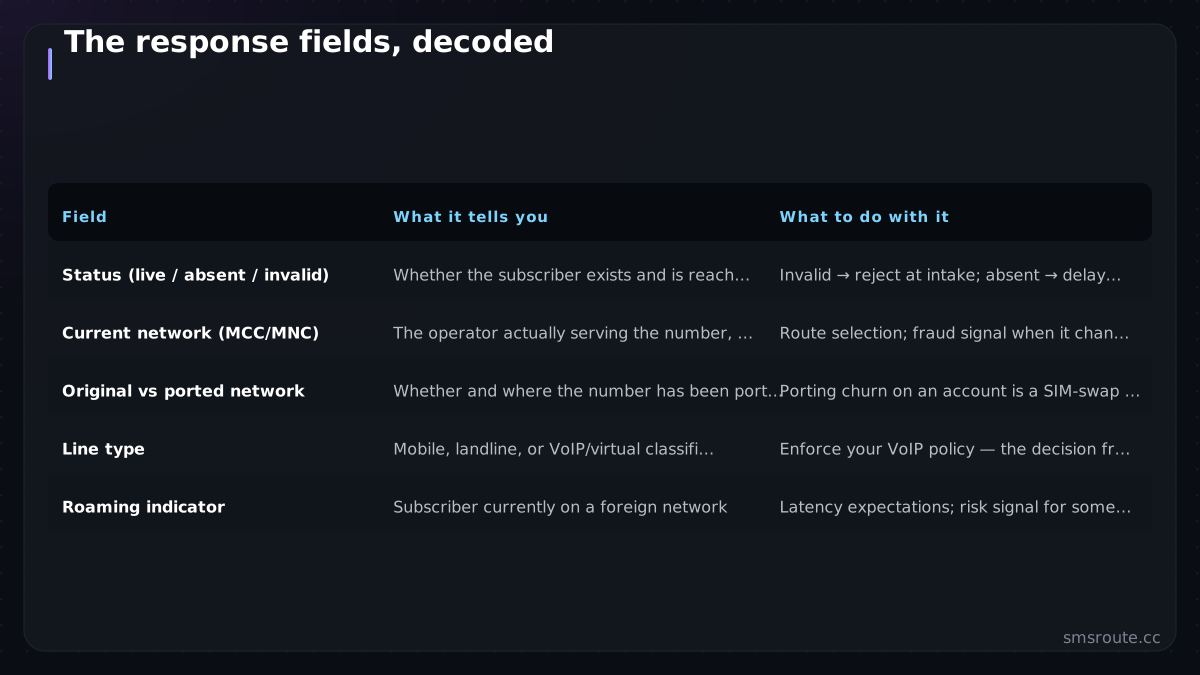
The response fields, decoded
| Field | What it tells you | What to do with it |
|---|---|---|
| Status (live / absent / invalid) | Whether the subscriber exists and is reachable now | Invalid → reject at intake; absent → delay or deprioritize the send |
| Current network (MCC/MNC) | The operator actually serving the number, post-porting | Route selection; fraud signal when it changes suddenly |
| Original vs ported network | Whether and where the number has been ported | Porting churn on an account is a SIM-swap risk input |
| Line type | Mobile, landline, or VoIP/virtual classification | Enforce your VoIP policy — the decision framework in our VoIP guide |
| Roaming indicator | Subscriber currently on a foreign network | Latency expectations; risk signal for some geos |
None of these fields identifies a person. An HLR response describes a number's network state. It is subscriber-privacy-neutral in the way a DNS query is, which is also why it is the rare anti-fraud tool with no data-minimisation cost, a property our data-minimisation guide covers in full.
The three places a lookup pays for itself
- At signup, before the first OTPReject invalid and unallocated numbers instantly, apply your VoIP policy (allow, add friction, or block per our VoIP vs non-VoIP framework), and never pay to message a number that cannot receive it.
- Under attackSMS-pumping bots cycle through fraud-controlled ranges heavy with invalid and virtual numbers. A pre-send lookup plus the rate limits from our pumping defense guide removes most of the paid damage before it is paid for.
- On list hygieneDatabases rot: industry rules of thumb put contact-data decay above 20% a year. A periodic HLR sweep of a marketing or alert list strips the dead numbers, which is pure savings at bulk rates; our HLR overspend analysis runs the numbers.
The break-even arithmetic is short: a lookup costs a fraction of a message. If more than a few percent of your sends target dead, invalid, or policy-violating numbers (and for public signup forms that is nearly guaranteed), checking first is cheaper than sending blind.
Using it on SMSRoute, and the honest limits
SMSRoute is a no-KYC SMS API with crypto billing (BTC, ETH, USDT, XMR, LTC, and SOL), and the HLR lookup service is the validation half of the product: one API call per number, same balance as your messaging spend, results in the fields above. Wire it in front of the OTP send flow and both your delivery rate and your invoice improve on day one.
Honest limits, so you design around them rather than discover them: an HLR query cannot tell you who holds the phone, cannot guarantee a live handset will still be live seconds later, and coverage of fixed-line and some virtual ranges varies by market. It is a network-state check, not an identity check. Pair it with your rate limits and risk scoring, and it is the cheapest fraud-and-waste filter in the stack. SMSRoute's published route pages list delivery from $0.004/message (premium direct-carrier corridors up to $0.035) with sub-100ms median submission and ~98.6% delivered success (smsroute.cc route pages, 2026).
Related reading
FAQ
What does an HLR lookup return?
What is the difference between HLR and MNP lookup?
How much does an HLR lookup cost?
Can an HLR lookup detect VoIP numbers?
Send your first SMS in 5 minutes
No KYC. Pay with BTC, ETH, USDT, XMR, LTC, and SOL. Live routes to 149 countries.
Get an API key →