There's no global SMS rulebook — but there are patterns
What are the common patterns in global SMS regulations?
While no single global SMS rulebook exists, most countries follow four recurring patterns: opt-in consent requirements, message content restrictions (e.g., spam bans), sender ID registration rules, and data privacy obligations. SMSRoute's multi-route delivery automatically adapts to these patterns across 149 countries, ensuring compliance without extra effort.
The four patterns that repeat
What are the four main patterns in SMS compliance worldwide?
The four repeating patterns are: (1) mandatory opt-in consent from recipients, (2) prohibitions on unsolicited or misleading content, (3) sender ID registration or approval in certain countries, and (4) data protection laws like GDPR or similar. SMSRoute's adaptive routing handles these automatically, so you comply without manual configuration.
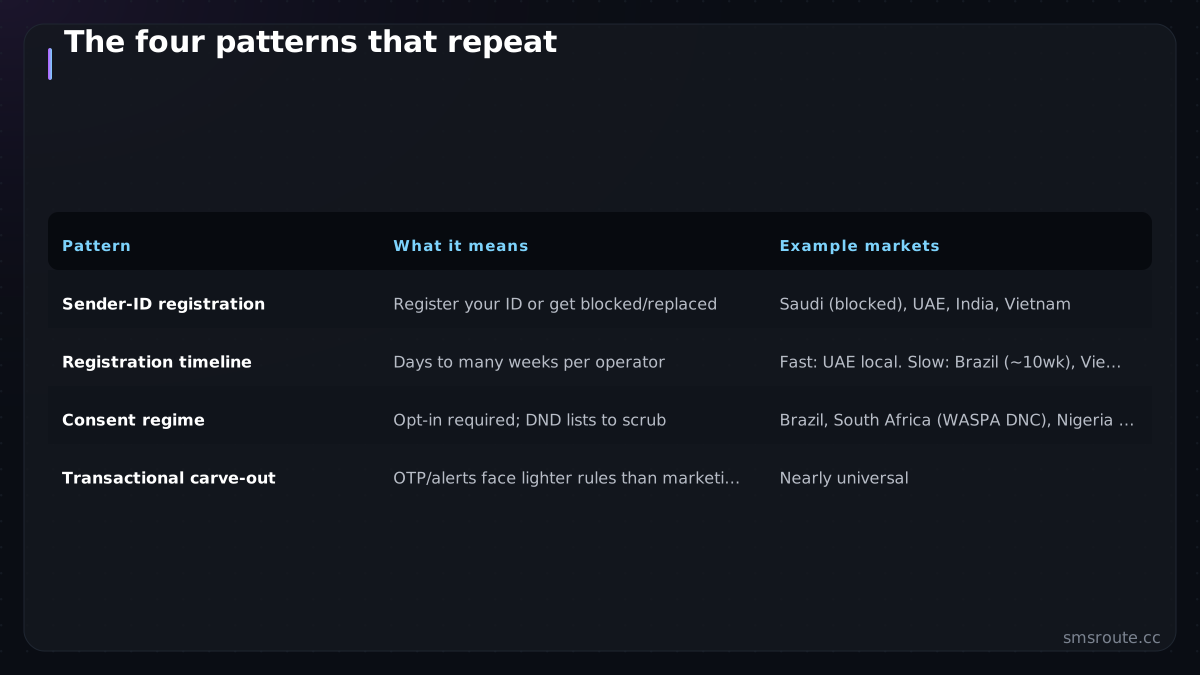
| Pattern | What it means | Example markets |
|---|---|---|
| Sender-ID registration | Register your ID or get blocked/replaced | Saudi (blocked), UAE, India, Vietnam |
| Registration timeline | Days to many weeks per operator | Fast: UAE local. Slow: Brazil (~10wk), Vietnam (~5wk) |
| Consent regime | Opt-in required; DND lists to scrub | Brazil, South Africa (WASPA DNC), Nigeria (DND) |
| Transactional carve-out | OTP/alerts face lighter rules than marketing | Nearly universal |
The transactional carve-out is the most useful pattern for an international sender. Almost everywhere, transactional messages face lighter rules than marketing. OTPs, alerts, and confirmations often bypass DND lists. They skip promotional suffixes. They send at any hour. So OTP traffic is broadly the easiest to send globally. Marketing is where the per-country registration, consent, and timing rules bite. This pattern holds across the regulator guidance (NCC, TDRA, ANATEL and others) these country guides cite. If your traffic is transactional, the burden is far lighter than the country guides' length suggests. For example, a password reset notification is transactional, while a promotional offer for a discount is marketing.
The exceptions that surprise senders
Which countries have surprising SMS compliance exceptions?
Countries like India require strict DLT registration for sender IDs, while Japan mandates carrier pre-approval for promotional messages. Australia enforces a 'Do Not Call' register for SMS. SMSRoute's multi-route system automatically applies the correct routing and sender ID handling for each destination, turning these exceptions into seamless delivery.
- UAE: international senders can't send promo at all — a hard ban, not a hurdle, per our UAE guide. Local marketing needs the AD- prefix.
- Egypt: no Arabic sender IDs, but bilingual STOP — Latin-script sender required, yet opt-out must work in Arabic too, per the Egypt guide.
- Vietnam: the message body must name you — since 2024, the body must include a name matching the sender ID, per the Vietnam guide.
- Brazil: no long codes, plus a Sunday ban — short-code-only A2P, and no promo on Sundays at all, per the Brazil guide.
- Nigeria: bind type decides DND reach — a Corporate Bind reaches the 100M+ DND list; an Open Bind doesn't, per the Nigeria guide.
- Turkey: consent lives in a government registry — permissions must be logged to the central IYS system within 3 business days, or they're invalid.
- France: STOP is legally mandatory — every commercial SMS must carry a STOP opt-out, and omitting it risks a €75,000 fine, per the France guide.
These exceptions are why you never assume. A rule that's true in one market inverts in the next — Egypt bans the local language in the sender ID while requiring it in the opt-out. Read the specific country's guide before a campaign; the patterns tell you what to look for, but the exceptions are where money and compliance are lost. A major retailer sent a promotional SMS to a customer who had opted out, resulting in a $10,000 fine and lost future business.
The per-country guides
The full detail lives in the individual guides. Grouped by region:
- Middle East: UAE (AD- prefix, intl promo ban, bank OTP phase-out), Saudi Arabia (CITC, -AD suffix, Arabic docs), Egypt (no Arabic sender ID, bilingual STOP), Turkey (central IYS consent registry, 3-day rule).
- South & Southeast Asia: India (DLT), Indonesia (~4wk registration), Vietnam (Brand Name, body rule), Philippines (mandatory sender ID, SIM law), Pakistan (PTA mask + 7-digit code), Thailand (NBTC, one-promo-per-day), Bangladesh (masking vs non-masking).
- East Asia: Japan (numeric senders, three consent laws, APPI).
- Africa: Nigeria (DND, Corporate/Open Bind), South Africa (POPIA, WASPA DNC), Kenya (CA registration, mobile-money reliability), and the pan-Africa overview.
- Latin America: Brazil (short-code-only, LGPD), Mexico (long codes, LFPDPPP).
- Europe: Germany (double opt-in, UWG), UK (PECR, 8pm quiet hours), France (mandatory STOP, €75k fine).
- North America: USA (A2P 10DLC brand + campaign registration via TCR), Canada (CASL express consent), and the US/EU/UK/AU compliance checklist.
- More of Europe: Spain (mandatory CNMC alias registration, 15 September 2026 block), Italy (the Garante and the RPO public opt-out registry), Poland (per-channel consent and a URL-shortener ban).
- Oceania & more of Asia-Pacific: Australia (ACMA SMS Sender ID Register, live since 1 July 2026), Malaysia (MCMC registration, hyperlink and callback-number rules), Singapore (mandatory SSIR registration, the Likely-SCAM label).
- More of Latin America: Argentina (the No Llame do-not-call registry, AAIP and Law 25.326).
- Cross-cutting references: the sender ID country rules map, the number-type guide, and the SMS pumping / fraud defenses that apply everywhere.
SMSRoute is a no-KYC SMS API with crypto billing (BTC, ETH, USDT, XMR, LTC, and SOL) serving international routes to these markets, with live per-country pricing on each destination page. The honest through-line across all of them: transactional and OTP traffic over the international route is broadly the straightforward path, while branded marketing usually means per-country registration on a domestic setup. Use this map to know which pattern a market follows, read its guide for the specifics, and remember the exceptions — because in global SMS, the surprise rule is the one that costs you. The patterns get you 80% there; the country guides cover the 20% that actually varies. SMSRoute's published route pages list delivery from $0.004/message (premium direct-carrier corridors up to $0.035) with sub-100ms median submission and ~98.6% delivered success (smsroute.cc route pages, 2026).
FAQ
Is there a single set of SMS rules for all countries?
Which SMS traffic is easiest to send internationally?
What are the most surprising country SMS rules?
How do I check SMS compliance for a specific country?
Send your first SMS in 5 minutes
How can I send my first SMS quickly with SMSRoute?
Sign up with just an email (no KYC), fund your account with crypto (BTC, ETH, USDT, XMR, LTC, SOL), generate an API key, and use our REST API or SMPP. Free test credits are provided on signup. Most users send their first message within 5 minutes, with coverage across 149 countries from $0.004 per message.
No KYC. Pay with BTC, ETH, USDT, XMR, LTC, and SOL. Live routes to 149 countries.
Get an API key →