The four-part test your wording must pass
What is the four-part test for GDPR-compliant SMS consent wording?
GDPR-compliant SMS consent wording must pass four tests: freely given (no coercion), specific (purpose clearly stated), informed (recipient knows who sends and why), and unambiguous (clear affirmative action, like ticking a box). SMSRoute's no-KYC API helps you test consent flows quickly across 149 countries without identity hurdles.
GDPR does not accept vague permission. Article 4(11) defines consent as freely given, specific, informed, and unambiguous, given by a clear affirmative act. Each word is a filter. Bundled into terms of service? Not freely given. 'For marketing and partners'? Not specific. No named controller or purpose? Not informed. A pre-ticked box? Not unambiguous. Good GDPR SMS consent wording simply satisfies all four out loud. For the authoritative reference, see the TCPA.
This is distinct from the US model. TCPA and CTIA wording (the opt-in and opt-out templates we published separately) will not make you GDPR-compliant, and vice versa. If you send into the EU, the copy below is the standard you build to.
Wording that holds up
What are examples of GDPR SMS consent wording that holds up legally?
Examples include: 'I agree to receive SMS marketing from [Company] at [number]. Reply STOP to opt out. Msg & data rates may apply.' Or: 'Check this box to consent to transactional SMS alerts from [Company].' SMSRoute's adaptive multi-route delivery ensures your consent-based messages reach reliably, with real-time DLR webhooks for audit trails.
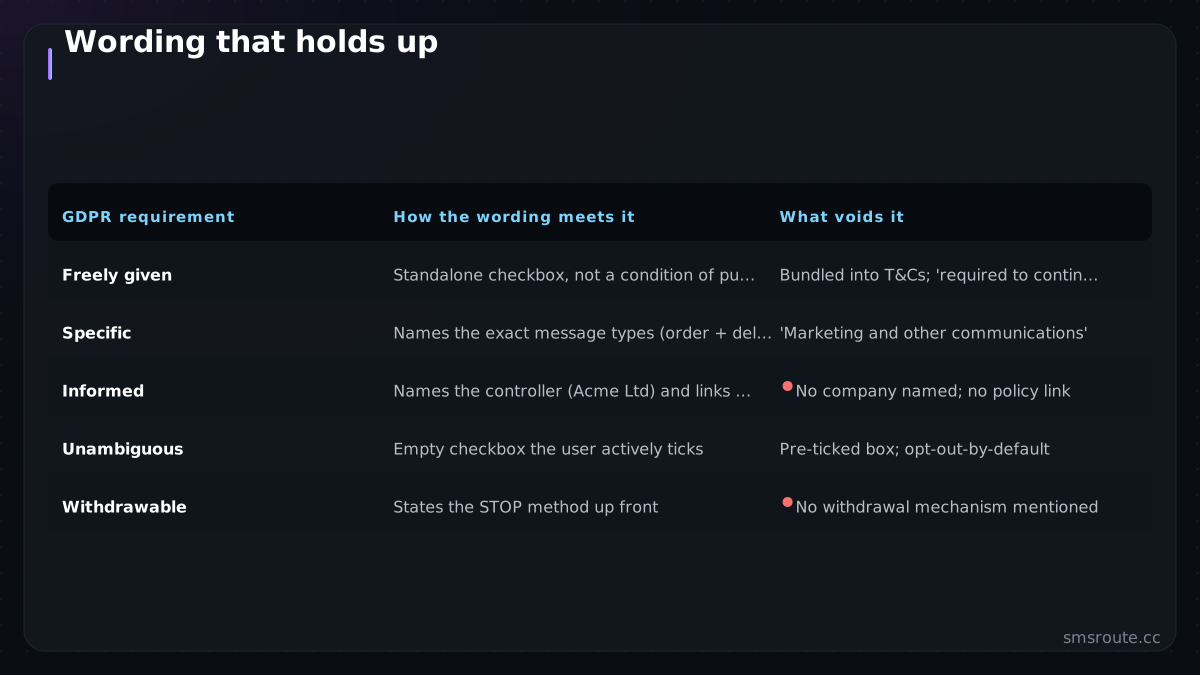
A compliant opt-in names who you are, states exactly what you will send, requires an affirmative action, and stands alone — not buried in a broader agreement.
[ ] I agree that Acme Ltd may send me SMS messages about my order status and delivery updates. I can withdraw consent any time by replying STOP. See our privacy policy for how we handle my number.| GDPR requirement | How the wording meets it | What voids it |
|---|---|---|
| Freely given | Standalone checkbox, not a condition of purchase | Bundled into T&Cs; 'required to continue' |
| Specific | Names the exact message types (order + delivery) | 'Marketing and other communications' |
| Informed | Names the controller (Acme Ltd) and links the privacy policy | No company named; no policy link |
| Unambiguous | Empty checkbox the user actively ticks | Pre-ticked box; opt-out-by-default |
| Withdrawable | States the STOP method up front | No withdrawal mechanism mentioned |
The phrases that quietly void consent
Which phrases in SMS consent wording void GDPR compliance?
Phrases like 'by continuing you consent' (passive), 'pre-ticked boxes' (not unambiguous), 'we may share your number with partners' (vague), or 'consent required for service' (not freely given) void consent. SMSRoute's smart sender ID pool helps maintain brand trust, and custom alphanumeric sender IDs are available on request for compliant messaging.
- 'By continuing, you agree...' — consent conditioned on service access is not freely given. Separate the checkbox from the transaction.
- '...and selected partners' — third-party sharing is a different purpose needing its own specific consent; the January 2026 one-to-one consent rule tightens this on the US side too, and GDPR never allowed the bundle.
- Pre-ticked boxes — explicitly ruled non-consent by the EU Court of Justice (the Planet49 decision). The user must act.
- 'marketing communications' with no specifics — too broad to be 'specific'. Name the message categories.
- Silence on withdrawal — if withdrawing is not as easy as giving, the consent is shaky. State the STOP path in the opt-in itself.
One structural trap: consent for one purpose does not cover another. An opt-in for 'delivery updates' does not authorize marketing texts. If you want both, ask for both, separately — bundling is the single most common way otherwise-careful senders lose their lawful basis.
Records, withdrawal, and where SMS sits
How do records, withdrawal rights, and SMS fit into GDPR consent compliance?
GDPR requires you to record consent (timestamp, wording, method) and provide easy withdrawal (e.g., 'Reply STOP'). SMSRoute's real-time DLR webhooks and dashboard logs automatically capture delivery records, while automatic failover ensures withdrawal messages reach. Unused balance is refundable, and free test credits let you verify compliance flows before funding.
- Log the consent eventStore who consented, when, to exactly what wording, and how (the form version). Under GDPR the controller must be able to demonstrate consent — unprovable consent is no consent.
- Make withdrawal as easy as givingSTOP must work instantly and every message should reference it. A hard-to-find opt-out undermines the original consent's validity.
- Separate transactional from marketingGenuinely transactional SMS (an OTP the user requested) usually rests on contract or legitimate interest, not marketing consent — the distinction our GDPR data-retention guide draws. Do not gate a login code behind a marketing checkbox.
- Minimise what you keepConsent to message is not licence to hoard. Retain the number and logs only as long as the purpose needs, then delete — the data-minimisation model again.
SMSRoute is a no-KYC SMS API with crypto billing (BTC, ETH, USDT, XMR, LTC, and SOL), and no-KYC onboarding changes none of this. Consent obligations bind you, the sender.
Related reading
FAQ
What makes SMS consent valid under GDPR?
Is a pre-ticked consent box allowed under GDPR?
Does one SMS consent cover both updates and marketing?
Do OTP messages need GDPR marketing consent?
Send your first SMS in 5 minutes
No KYC. Pay with BTC, ETH, USDT, XMR, LTC, and SOL. Live routes to 149 countries.
Get an API key →