What a burner number actually is
What is a burner number and how does it work?
A burner number is a temporary phone number used for short-term communication, often for privacy or one-time verification. Unlike permanent lines, it can be discarded after use. SMSRoute offers no-KYC access to send SMS from virtual numbers across 149 countries, with crypto billing and instant setup.
A burner number is a temporary phone number you get from an app like Burner, Hushed, or Google Voice. You pay a subscription or per-month fee. You can receive calls and texts, reply, and keep the number as long as you pay. It's tied to your real identity through the app's payment and account system. You're anonymous to the people you call, but not to the app vendor.
Burner numbers are for ongoing conversations. You use them for dating, selling stuff on Craigslist, or signing up for services that need a phone number. You can call back. You can receive replies. The number is yours until you stop paying.
What an anonymous SMS sender is
What is an anonymous SMS sender and how does it differ from a burner number?
An anonymous SMS sender lets you send text messages without revealing your personal phone number or identity. Unlike burner numbers, it doesn't require a temporary line. Just an API key. SMSRoute provides this via a no-KYC signup, crypto billing, and real-time delivery reports, starting at $0.004 per message.
An anonymous SMS sender (like SMSRoute) is the opposite. You don't get a number. You don't get an account. You don't subscribe. You pay per message in crypto (typically $0.03 to $0.10 per SMS) and send a one-way text. The recipient sees a random or generic sender ID, not a number they can reply to. You can't receive replies. There's no subscription, no personal data stored, no identity link at all.
This tool is for one-shot messages. Send a tip to a journalist. Notify someone anonymously. Deliver a code or alert without leaving a digital trail. The sender remains completely untraceable: no account, no phone number, no payment card.
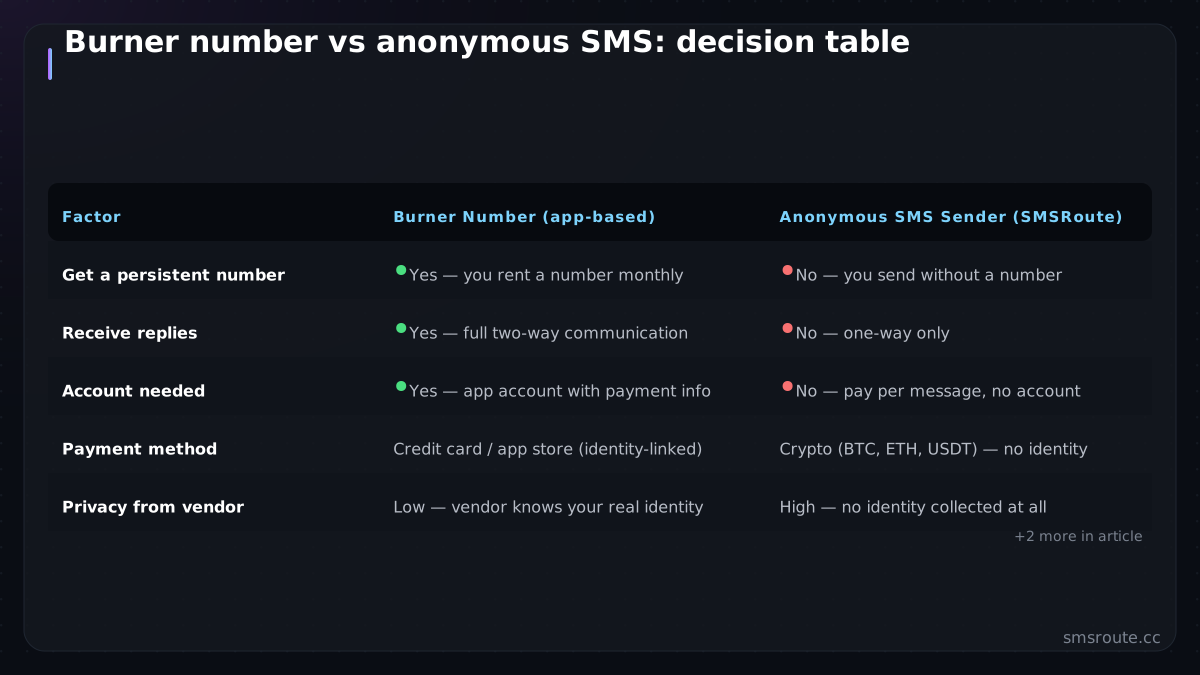
Burner number vs anonymous SMS: decision table
What are the key differences between a burner number and an anonymous SMS service?
A burner number is a disposable phone line for receiving calls and texts, while an anonymous SMS sender focuses on sending messages without identity exposure. SMSRoute's anonymous SMS API offers instant setup, no KYC, and crypto billing. It's ideal for developers needing privacy without managing temporary numbers.
| Factor | Burner Number (app-based) | Anonymous SMS Sender (SMSRoute) |
|---|---|---|
| Get a persistent number | Yes — you rent a number monthly | No — you send without a number |
| Receive replies | Yes — full two-way communication | No — one-way only |
| Account needed | Yes — app account with payment info | No — pay per message, no account |
| Payment method | Credit card / app store (identity-linked) | Crypto (BTC, ETH, USDT, XMR, LTC, and SOL) — no identity |
| Privacy from vendor | Low — vendor knows your real identity | High — no identity collected at all |
| Best for | Ongoing conversations, dating, classifieds, signups needing a number | One-shot tips, alerts, notifications, privacy-critical messages |
| Cost model | Subscription ($5-15/month) | Per message ($0.03-0.10) |
The core question: do you need a two-way conversation? If yes, get a burner number. If no, an anonymous SMS sender is cheaper, more private, and leaves
When to use each — and the honest limits
Burner numbers work well for ongoing chats. But they're not truly anonymous. The app knows who you are. And you pay a monthly fee even if you send zero messages. Some services also block known burner number ranges. Industry estimates put SMS verification rejection rates for burner numbers in the low double digits.
Anonymous SMS senders are perfect for one-shot messages. But they can't receive replies. And some recipients distrust messages from unknown sender IDs. Use them responsibly. No spam, no harassment, no illegal content. SMSRoute's terms prohibit abuse, and destination-country laws still apply. See our responsible use guide for details. In Germany, opt-in consent is required under §7 UWG. In India, TRAI regulations mandate a 10-digit sender ID for transactional messages.
For a deeper look at privacy trade-offs, read our anonymous SMS API guide. For the full comparison with other temporary number options, see temporary vs virtual vs burner numbers.
How to send an anonymous SMS with SMSRoute
How can I send an anonymous SMS using SMSRoute?
Sign up with just an email (no KYC), fund your account with crypto (BTC, ETH, USDT, XMR, LTC, SOL), get your API key, and send your first message in minutes. SMSRoute covers 149 countries with automatic failover and real-time DLR webhooks. Start from $0.004 per message.
- Fund with cryptoDeposit BTC, ETH, or USDT. No account, no KYC, no card. Your balance is ready in minutes.
- Get your API keyThe key appears instantly in the dashboard. No approval queue.
- Send your messageOne HTTPS POST. The recipient sees a sender ID, not a number. No reply possible.
curl -X POST https://api.smsroute.cc/sms/send \
  -H 'Authorization: Bearer YOUR_API_KEY' \
  -H 'Content-Type: application/json' \
  -d '{"to": "+2348012345678", "from": "SenderID", "message": "Your anonymous message here"}'
That's it. No subscription, no number to manage, no identity trail. SMSRoute is a no-KYC SMS API with crypto billing. It's built for exactly this use case. Get started in five minutes.
Related reading
FAQ
What's the main difference between a burner number and an anonymous SMS sender?
Can I receive replies with an anonymous SMS sender?
Is using an anonymous SMS sender legal?
Which is more private — a burner number or an anonymous S
Send your first SMS in 5 minutes
No KYC. Pay with BTC, ETH, USDT, XMR, LTC, and SOL. Live routes to 149 countries.
Get an API key →