
The best time to send SMS directly affects your open rates and delivery success. Schedule messages when recipients are most receptive — late morning (10 AM–12 PM) and early evening (4 PM–6 PM) local time — and you will see higher engagement. Send outside these windows, and you risk carrier throttling, spam flags, and annoyed recipients who may opt out. This guide covers timezone-aware send tables, industry-specific scheduling windows, and how to schedule SMS messages programmatically with SMSRoute's SMS API without KYC or account registration.
- Why send time matters for SMS open rates and delivery success
- Best time to send SMS by timezone — practical reference table
- Best time to send SMS by industry: retail, healthcare, finance, and more
- How to schedule SMS messages with SMSRoute's API
- How message length affects SMS cost and campaign scheduling
- Honest limits of send time optimization
- SMSRoute vs other SMS gateways for scheduled delivery
Why Send Time Matters for SMS Open Rates and Delivery Success
The best time to send SMS is not a fixed hour — it depends on your recipient's timezone, daily routine, and message type. Carriers enforce traffic-shaping policies during off-peak hours, and regulators in many countries set quiet-hour rules for promotional messaging. India's TRAI, for example, restricts promotional SMS to 9 AM–9 PM local time. EU ePrivacy guidelines encourage similar norms across member states.
GSMA benchmarks show that SMS open rates peak at 10 AM–12 PM and again at 4 PM–6 PM local time, with 30–40% higher engagement compared to lunchtime or late-night sends. For transactional messages like OTPs and delivery alerts, speed matters more than timing. SMSRoute's direct routes deliver with sub-100ms median latency across 149 countries, making send time optimization less critical for time-sensitive alerts.
For marketing and promotional campaigns, however, send-time optimization directly impacts conversion rates. Messages that arrive during quiet hours risk spam classification or carrier blocks. SMSRoute's global network routes around these constraints, but you still control the send window through the API documentation and web sender.
Best Time to Send SMS by Timezone — Practical Reference Table
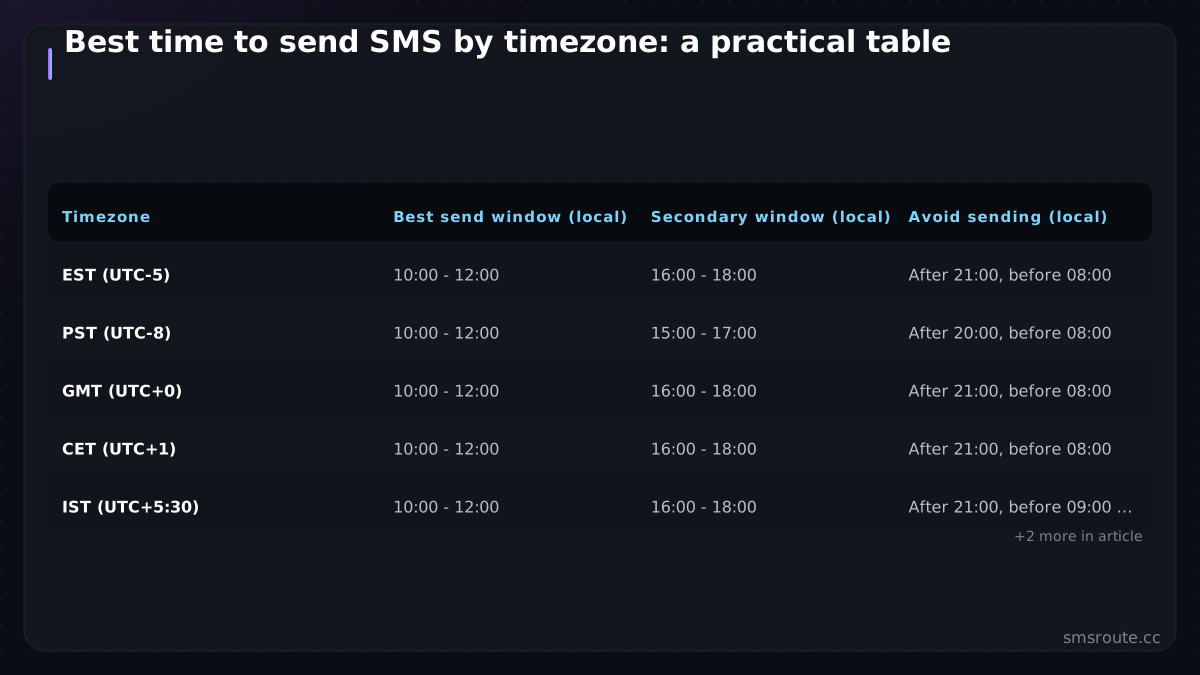
The recommended send windows vary by timezone due to local business hours, commute patterns, and regulatory quiet hours. The table below provides timezone-aware scheduling guidance for major global regions. Use it as a starting point, then A/B test with your own audience for precise optimization.
| Timezone | Best window (local) | Secondary window (local) | Avoid |
|---|---|---|---|
| EST (UTC-5) | 10 AM–12 PM | 4 PM–6 PM | After 9 PM, before 8 AM |
| PST (UTC-8) | 10 AM–12 PM | 3 PM–5 PM | After 8 PM, before 8 AM |
| GMT (UTC+0) | 10 AM–12 PM | 4 PM–6 PM | After 9 PM, before 8 AM |
| CET (UTC+1) | 10 AM–12 PM | 4 PM–6 PM | After 9 PM, before 8 AM |
| IST (UTC+5:30) | 10 AM–12 PM | 4 PM–6 PM | After 9 PM, before 9 AM (TRAI) |
| JST (UTC+9) | 10 AM–12 PM | 3 PM–5 PM | After 8 PM, before 8 AM |
| AEST (UTC+10) | 10 AM–12 PM | 4 PM–6 PM | After 9 PM, before 8 AM |
For global campaigns, segment recipients by timezone and schedule per group. SMSRoute's API accepts a
timezone_offset parameter, letting you group by UTC offset and deliver at the correct local time. A
neutral send time like 14:00 UTC covers most timezones reasonably — 10 AM in New York, 7 PM in Dubai, and 11 PM
in Tokyo. For precise delivery in regulated markets like India, see the guide on no-KYC SMS in India.
Best Time to Send SMS by Industry: Retail, Healthcare, Finance, and More
Each industry vertical has a different optimal send window depending on when recipients are most receptive. A retail flash sale works best during lunch browsing. A healthcare appointment reminder should arrive before morning hours. A financial alert needs to reach during market hours. Here are the recommended windows by vertical:
- Retail and e-commerce — 12 PM–2 PM (lunch browsing) or 6 PM–8 PM (evening shopping). Flash sales and cart abandonment reminders perform best in these windows.
- Healthcare and appointments — 8 AM–10 AM (before morning appointments) or 4 PM–6 PM (next-day reminders). Never send after 8 PM for health-related messages.
- Finance and banking — 9 AM–11 AM (market open) or 2 PM–4 PM (transaction confirmations). Time-sensitive alerts like fraud detection should send immediately regardless of window.
- Logistics and delivery — 7 AM–9 AM (morning delivery windows) or 5 PM–7 PM (evening delivery updates). Avoid peak traffic hours.
- Education and events — 10 AM–12 PM or 2 PM–4 PM. Avoid weekends for academic communications.
For precise optimization, run A/B tests with your audience. SMSRoute's pricing page shows per-country rates, so you can estimate campaign costs before testing send windows.
How to Schedule SMS Messages with SMSRoute's API
SMSRoute's HTTP API supports scheduled delivery through the send_at parameter in Unix timestamp
format. Pass the recipient's UTC offset via timezone_offset, and the system adjusts delivery to the
correct local time. Messages can be scheduled up to 7 days in advance. SMSRoute delivers SMS to over 149
countries with typical delivery times under 100ms on Tier-1 routes.
curl -X POST https://api.smsroute.cc/sms/send \
      -H "Content-Type: application/json" \
      -H "Authorization: Bearer YOUR_API_KEY" \
      -d '{
        "to": "+1234567890",
        "from": "YourBrand",
        "message": "Your appointment is tomorrow at 10 AM."
      }'
The web sender supports manual date-time selection and automatically converts to UTC. For batch campaigns, loop
through recipient groups with different timezone_offset values. No KYC, account registration, or
monthly subscription required. Pay per message in BTC, ETH, USDT, XMR, LTC, or SOL. Pricing starts at $0.004/msg
on Tier-1 routes. See the open SMS pricing dataset
on GitHub for current rates by country.
SMSRoute also supports the SMPP protocol for high-volume senders who need dedicated connections. First-message delivery takes approximately 60 seconds on direct routes. For technical details, refer to the API reference.
How Message Length Affects SMS Cost and Campaign Scheduling
Message length determines how many segments your SMS uses, and each segment is billed separately. A single GSM-7 segment holds 160 characters. UCS-2 encoding (needed for Unicode characters, including emoji) allows 70 characters per segment. A 200-character message in GSM-7 splits into two segments and costs double a single-segment message.
Use SMSRoute's free SMS character counter to check message length before sending, and the SMS cost calculator to estimate per-route pricing. Both tools require no account. For encoding details, see the SMS character limit guide.
Honest Limits of Send Time Optimization
Even perfect timing has real constraints. Here are five factors that affect delivery beyond your send window:
- Carrier filtering — Shared sender IDs may trigger spam filters regardless of timing. SMSRoute's Tier-1 direct routes achieve ~98% delivery rates on major networks.
- Roaming numbers — A +1 number may roam in Europe. The message lands at the network's local time, not
the recipient's home timezone. Use explicit
timezone_offsetwhen possible. - Plain-text delivery — SMS lacks end-to-end encryption. Never send passwords, full credit card numbers, or other sensitive data via SMS.
- Regulatory compliance — India, Brazil, and EU countries enforce strict promotional SMS rules. Check local laws before sending campaigns. See the no-KYC SMS in India guide for TRAI-specific requirements.
- Inbound support — Dedicated inbound numbers are available on request for two-way communication. Contact support to enable this for your account.
SMSRoute vs Other SMS Gateways for Scheduled Delivery
Twilio, MessageBird, and Plivo all offer send scheduling and timezone detection — but require KYC, account registration, and monthly commitments. SMSRoute delivers the same scheduling capabilities with zero signup friction: no account, no KYC, pay per message in cryptocurrency, and access direct carrier routes to 149 countries.
SMSRoute supports both HTTP API and SMPP protocol, provides sub-100ms median delivery latency, and publishes open pricing data for full transparency. For a detailed comparison of SMS API providers across pricing, delivery rates, and features, see the international SMS API comparison guide. For information on crypto payment workflows, read how to pay for SaaS with Bitcoin.
Frequently Asked Questions
What is the best time to send SMS for high open rates?
Does the best time to send SMS vary by country?
Can I schedule SMS messages in advance with SMSRoute?
How much does bulk SMS cost per message?
What happens if I send an SMS at the wrong time?
How is SMSRoute different from other SMS gateways?
Send your first SMS in 5 minutes
No KYC. No account needed. Pay with BTC, ETH, USDT, XMR, LTC, or SOL. Live routes to 149 countries from $0.004/msg.
Get an API key →