The decision that comes before the provider
Every guide to picking an SMS API in India starts with a provider list. That is backwards. India's TRAI regime splits the market into two legal routes with different economics, different sender IDs, and different provider pools — so your first decision is the route, and it is determined by one question: is your sending entity Indian, messaging Indian customers domestically? If yes, you are in DLT territory, full stop. If you are a foreign business reaching Indian users, the international route is open to you and usually simpler. For the authoritative reference, see TRAI's commercial-messaging rules.
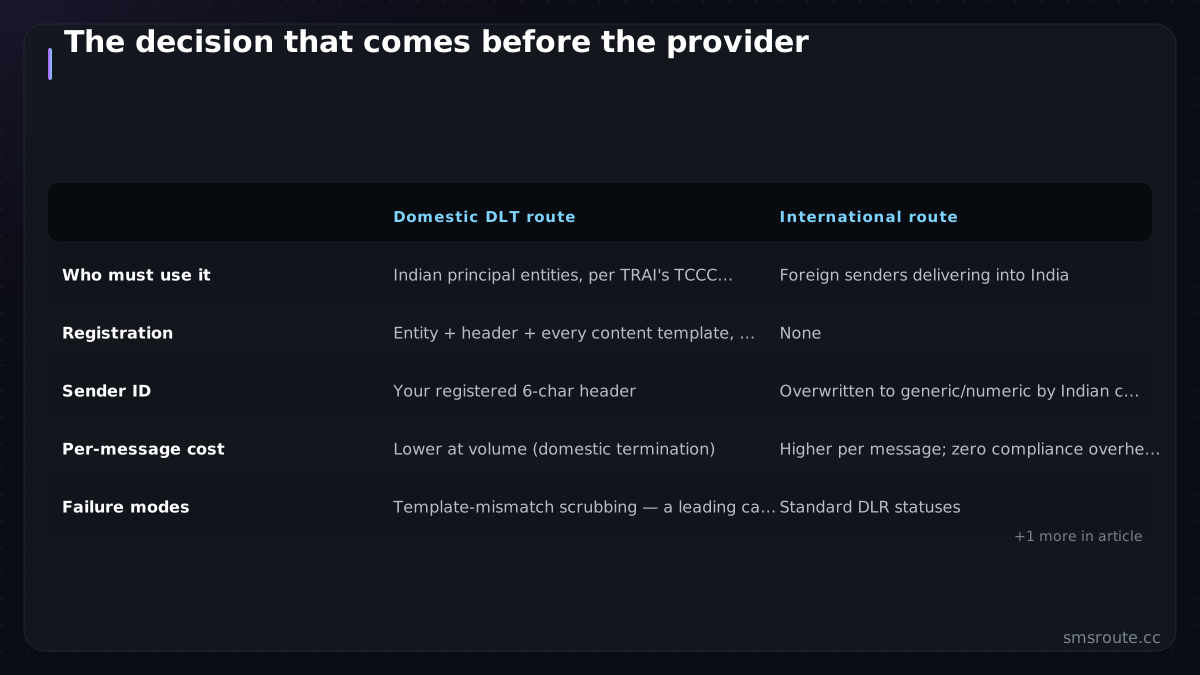
We covered the regulatory mechanics in depth in our DLT registration guide; the short version of the split is this table.
| Domestic DLT route | International route | |
|---|---|---|
| Who must use it | Indian principal entities, per TRAI's TCCCPR 2018 | Foreign senders delivering into India |
| Registration | Entity + header + every content template, on a carrier DLT platform | None |
| Sender ID | Your registered 6-char header | Overwritten to generic/numeric by Indian carriers |
| Per-message cost | Lower at volume (domestic termination) | Higher per message; zero compliance overhead |
| Failure modes | Template-mismatch scrubbing — a leading cause of silent drops, per Message Central's 2026 India guide | Standard DLR statuses |
| Lead time | Days to weeks (approvals) | Minutes |
Ranking criteria that actually separate providers
- Route transparency. Can the provider say how it terminates traffic into Jio, Airtel, and Vi? Vague answers at suspiciously low prices mean grey routes. The failure mechanics from our grey-route explainer apply to India with extra force, since Indian carrier filtering is among the world's most aggressive.
- Published India rate. The honest per-message price to India should be public before you sign up. Ours is live on the send SMS to India page.
- Real DLRs, tested by you. Send to SIMs you control on all three major networks and time the deliveries. Ten test messages beat any sales deck.
- OTP latency percentiles, not averages. India's 2-second-barrier problem is real; ask for p95, and see our sub-second OTP analysis for what good looks like.
- Onboarding that matches your situation. DLT route: the provider should guide you through entity and template registration end to end. International route: sign-up should take minutes with no documents, matching how a no-KYC India route actually works.
What OTP traffic to India costs, honestly
Domestic DLT rates at volume sit near ₹0.10-0.25 per message depending on operator deals. That is genuinely cheap, in exchange for the compliance overhead. International-route pricing to India runs higher (typical direct-route band around $0.01-0.02; the exact live figure is on the destination page), with zero registration cost and no template lock-in. Which total is lower depends on your volume and how much template churn your product generates: every copy change on DLT is a re-approval, and re-approvals are where launches stall.
Cross-check any provider's India quote against the honest band. Far below it means grey termination into a market whose firewalls will eat your OTPs. The 20-60% failure range industry analyses report for unregistered routes is not survivable for login flows.
Where SMSRoute fits, and where it does not
SMSRoute is a no-KYC SMS API with crypto billing (BTC, ETH, USDT, XMR, LTC, and SOL), and for India that specificity matters: we serve the international route. Foreign businesses sending OTP and transactional traffic to Indian users over direct carrier connections, generic sender ID and all, live rate published, first message in minutes via the 5-line integration. Design for the numeric sender by putting your app name in the message body, per our OTP copy guidance. SMSRoute's published route pages list delivery from $0.004/message (premium direct-carrier corridors up to $0.035) with sub-100ms median submission and ~98.6% delivered success (smsroute.cc route pages, 2026). For A2P traffic, ensure your message content is properly formatted; use the GSM-7 character set where possible to avoid unexpected segmentation, and always send numbers in international format (E.164) to reduce carrier filtering issues.
And where we honestly do not fit: if you are an Indian entity doing domestic marketing at scale, you need a DLT-registered domestic provider. Pick one that publishes its opera
Related reading
FAQ
What is the best SMS API in India?
Can a foreign company send OTP SMS to India without DLT?
How much does it cost to send SMS to India?
Why do OTPs to India fail so often?
Send your first SMS in 5 minutes
No KYC. Pay with BTC, ETH, USDT, XMR, LTC, and SOL. Live routes to 149 countries.
Get an API key →